Opposites are more than vocabulary tools. They are instruments of precision. In academic, political, and rhetorical writing, contrast creates clarity.
When a writer understands not only what a word means—but also what it does not mean—arguments become sharper, tone becomes controlled, and analysis becomes deeper.
The word “campaign” is especially powerful. It appears in politics, marketing, activism, warfare, fundraising, and even public health.
Because it carries energy, strategy, and forward motion, identifying its antonyms helps writers control narrative direction.
Replacing “campaign” with an opposite shifts tone from action to passivity, from mobilization to restraint, from organized effort to disengagement.
This article provides 20+ campaign antonyms with detailed explanations, contextual distinctions, emotional contrasts, academic applications, and practical exercises.
The goal is not merely to list opposites, but to analyze how and when to use them effectively.
Definition and Core Meaning of “Campaign”
Before identifying antonyms, we must understand the core semantic field of “campaign.”
A campaign refers to a coordinated, organized, and sustained effort to achieve a specific goal. It often includes planning, messaging, mobilization, and measurable objectives.
Common contexts include:
- Political campaign (election effort)
- Advertising campaign (marketing strategy)
- Military campaign (series of operations)
- Awareness campaign (public outreach)
- Fundraising campaign (resource mobilization)
Core semantic features:
- Intentional action
- Organized structure
- Active pursuit
- Strategic direction
- Public or group engagement
- Goal-oriented momentum
Therefore, strong antonyms will typically reflect:
- Inaction
- Withdrawal
- Disorganization
- Passivity
- Abandonment
- Neutrality
- Silence
- Retreat
Understanding these elements helps identify meaningful opposites rather than superficial ones.
Direct Opposites (Clear Contrasts)
Below are 20 strong antonyms that directly oppose the core energy and intention of a campaign:
Inactivity
Withdrawal
Retreat
Surrender
Abandonment
Silence
Neutrality
Neglect
Inaction
Passivity
Disengagement
Dissolution
Disorganization
Isolation
Repression
Suppression
Compliance
Submission
Stagnation
Ceasefire
These words clearly counter the action-driven nature of a campaign. However, not all are interchangeable. Their effectiveness depends on context.
Contextual Opposites
Some words function as antonyms only within specific contexts.
For example:
- In politics, “neutrality” opposes a campaign.
- In marketing, “neglect” or “inaction” may serve as opposites.
- In warfare, “ceasefire” or “surrender” acts as the contrast.
- In activism, “silence” becomes the most powerful opposite.
Thus, contextual antonyms depend on domain:
Political context:
- Withdrawal
- Neutrality
- Nonparticipation
Marketing context:
- Dormancy
- Inactivity
- Disengagement
Military context:
- Retreat
- Ceasefire
- Capitulation
Social activism context:
- Silence
- Apathy
- Compliance
Recognizing contextual differences prevents misuse in academic writing.
Emotional and Tone-Based Opposites
Campaign carries emotional intensity. It implies urgency, passion, movement, and collective energy.
Opposites often reduce intensity:
High intensity (campaign):
- Mobilized
- Strategic
- Aggressive
- Determined
Low intensity (antonyms):
- Passive
- Indifferent
- Silent
- Compliant
For example:
“A nationwide campaign” conveys urgency and drive.
“A period of silence” suggests stillness and emotional restraint.
Similarly:
“A military campaign” suggests force and expansion.
“A ceasefire” suggests pause and de-escalation.
The emotional shift is as important as the literal meaning.
20+ Campaign Antonyms Explained in Detail
Below are detailed explanations of more than twenty antonyms, including meaning, context, examples, and nuanced distinctions.
Inactivity
Meaning: Lack of action or movement.
Context: General opposite in any domain.
Example: The organization moved from active campaigning to complete inactivity.
Nuance: Neutral tone; does not imply intentional withdrawal, only absence of action.
Withdrawal
Meaning: Removal from active participation.
Context: Politics, military, social movements.
Example: The candidate announced his withdrawal from the race.
Nuance: Suggests conscious decision rather than laziness.
Retreat
Meaning: Strategic movement backward.
Context: Military and metaphorical use.
Example: The army abandoned its campaign and began a retreat.
Nuance: Implies pressure or failure.
Surrender
Meaning: Giving up resistance.
Context: Military or competitive settings.
Example: Instead of continuing the campaign, they chose surrender.
Nuance: Strong emotional connotation of defeat.
Abandonment
Meaning: Leaving something behind permanently.
Context: Policy or project discontinuation.
Example: The campaign ended in total abandonment of the initiative.
Nuance: Suggests neglect and finality.
Silence
Meaning: Absence of communication.
Context: Advocacy and awareness.
Example: Public silence replaced the earlier awareness campaign.
Nuance: Emotionally powerful; implies suppression or apathy.
Neutrality
Meaning: Refusal to take sides.
Context: Political discourse.
Example: The organization maintained neutrality instead of launching a campaign.
Nuance: Balanced and intentional, not necessarily negative.
Neglect
Meaning: Failure to give proper attention.
Context: Social or corporate responsibility.
Example: The issue suffered from years of neglect rather than structured campaigning.
Nuance: Suggests irresponsibility.
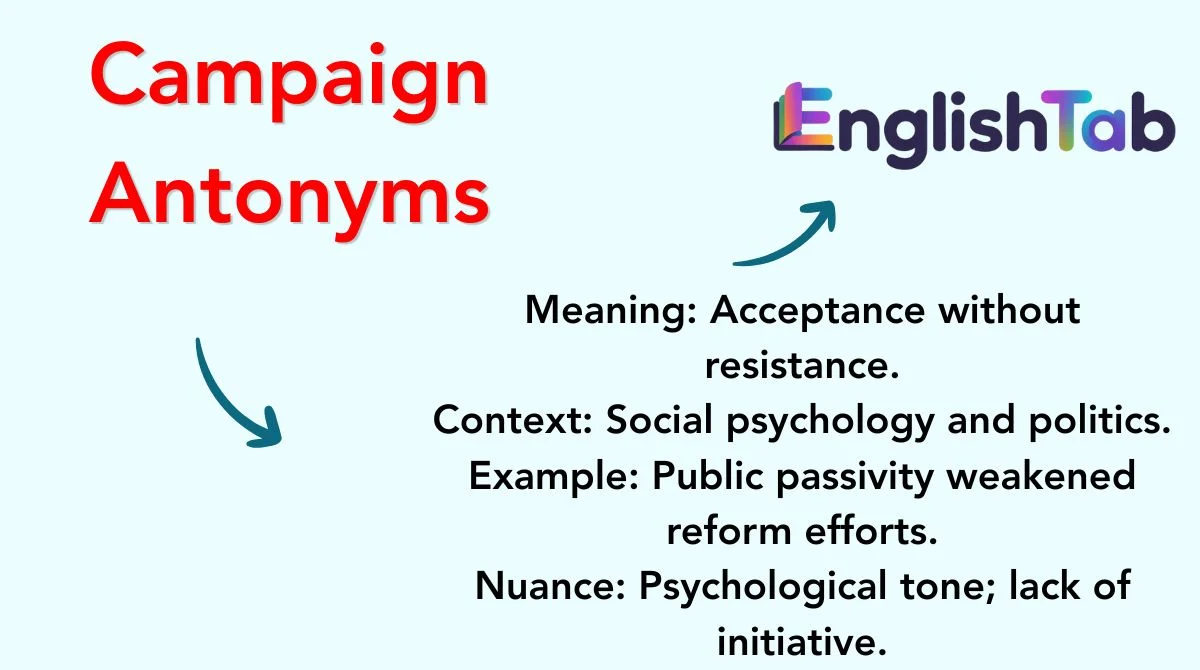
Passivity
Meaning: Acceptance without resistance.
Context: Social psychology and politics.
Example: Public passivity weakened reform efforts.
Nuance: Psychological tone; lack of initiative.
Disengagement
Meaning: Detachment from involvement.
Context: Corporate or civic participation.
Example: Voter disengagement followed the failed campaign.
Nuance: Suggests emotional distance.
Dissolution
Meaning: Formal ending of structure.
Context: Organizational efforts.
Example: The dissolution of the committee ended the campaign.
Nuance: Institutional and formal.
Disorganization
Meaning: Lack of structured coordination.
Context: Internal failure.
Example: Disorganization prevented the campaign from succeeding.
Nuance: Opposes the strategic nature of campaigns.
Isolation
Meaning: Separation from others.
Context: Diplomatic or political.
Example: The country chose isolation instead of diplomatic campaigning.
Nuance: Strategic distancing.
Suppression
Meaning: Forcing something to stop.
Context: Political resistance.
Example: Government suppression ended the protest campaign.
Nuance: Implies authority and force.
Compliance
Meaning: Obedience to authority.
Context: Legal or institutional.
Example: Instead of campaigning, the group showed compliance.
Nuance: Suggests acceptance of status quo.
Submission
Meaning: Yielding to power.
Context: Conflict situations.
Example: Submission replaced their initial campaign for reform.
Nuance: Strong emotional implication of defeat.
Stagnation
Meaning: Lack of progress.
Context: Economic or organizational.
Example: The industry experienced stagnation without innovation campaigns.
Nuance: Implies inactivity over time.
Ceasefire
Meaning: Agreement to stop fighting.
Context: Military.
Example: A ceasefire halted the military campaign.
Nuance: Temporary pause rather than surrender.
Apathy
Meaning: Lack of interest.
Context: Social engagement.
Example: Public apathy undermined the awareness campaign.
Nuance: Emotional disengagement.
Dormancy
Meaning: Inactive state.
Context: Business strategy.
Example: The brand entered dormancy after ending its campaign.
Nuance: Temporary pause.
Nonparticipation
Meaning: Choosing not to take part.
Context: Civic or institutional.
Example: Nonparticipation weakened the reform movement.
Nuance: Voluntary absence.
Antonym Comparison Table
| Word | Level of Intensity | Voluntary? | Emotional Tone | Domain Use |
|---|---|---|---|---|
| Withdrawal | Medium | Yes | Neutral | Politics |
| Retreat | High | Often No | Defensive | Military |
| Surrender | Very High | No | Defeat | Conflict |
| Neutrality | Low | Yes | Balanced | Diplomacy |
| Passivity | Low | Yes | Weak | Social behavior |
| Silence | Medium | Yes/No | Tense | Activism |
| Suppression | High | No | Authoritative | Politics |
| Compliance | Medium | Yes | Obedient | Legal |
| Stagnation | Low | No | Dull | Economic |
| Ceasefire | Medium | Yes | Strategic | Military |
This comparison highlights that not all antonyms carry the same emotional weight.
Academic Writing Examples
- The environmental campaign mobilized youth participation, whereas prolonged public apathy weakened reform momentum.
- The political campaign expanded voter outreach, in contrast to earlier periods of neutrality.
- The military campaign advanced territorial control, but the ceasefire restored temporary stability.
- Instead of launching a reform campaign, the administration adopted a strategy of compliance.
- The awareness campaign amplified community engagement; its abandonment led to stagnation.
These examples demonstrate how antonyms clarify argument structure.
When Not to Replace the Word
Avoid replacing “campaign” when:
- The text refers to a specific formal event (e.g., election campaign).
- The term carries technical meaning in historical or military analysis.
- Substituting weakens precision.
- The opposite introduces unintended emotional tone.
For instance, replacing “campaign” with “effort” reduces strategic nuance. Similarly, using “surrender” when you mean “pause” exaggerates meaning.
Precision matters more than variety.
Practice Exercises
Exercise 1
Replace “campaign” with an appropriate antonym:
- The government ended its vaccination campaign and entered a period of _______.
- The candidate’s campaign turned into complete _______ after defeat.
- The protest campaign shifted toward public _______ due to fear.
Exercise 2
Choose the strongest opposite:
- Military campaign
A. Neutrality
B. Ceasefire
C. Apathy - Awareness campaign
A. Silence
B. Retreat
C. Submission
Exercise 3
Write two academic sentences contrasting campaign with different antonyms.
FAQs
What is the strongest antonym of campaign?
The strongest antonym depends on context. In military usage, surrender is strongest. In political contexts, withdrawal or neutrality may be more accurate.
Is silence always an antonym of campaign?
Only in advocacy or awareness contexts. In marketing, silence may not function as a direct opposite.
Can compliance be considered an opposite?
Yes, when a campaign seeks change and compliance represents acceptance of existing authority.
Is retreat the same as surrender?
No. Retreat is strategic repositioning. Surrender implies defeat.
Why are contextual antonyms important?
Because meaning changes across domains. Precision strengthens academic writing.
Conclusion
Understanding campaign antonyms deepens analytical skill. A campaign represents organized, strategic, goal-driven action. Its opposites reflect passivity, withdrawal, silence, stagnation, or compliance.
By mastering more than twenty antonyms and analyzing their emotional intensity, contextual application, and nuanced differences, writers gain greater control over contrast.
Academic clarity emerges not only from defining what something is—but from understanding what it is not.
Opposites sharpen thought. Precision strengthens argument.
And vocabulary, when used carefully, transforms writing from simple description into structured analysis.

Dorian Hale is an English language enthusiast and content creator dedicated to making vocabulary and grammar learning simple, engaging, and accessible for everyone.