Precision in language determines the strength of academic, legal, and professional writing. One of the most effective tools for achieving clarity is contrast.
By understanding opposites, writers sharpen arguments, define boundaries, and eliminate ambiguity. Antonyms do more than reverse meaning—they reveal conceptual limits and strengthen reasoning.
The word breach is particularly powerful because it carries legal, ethical, emotional, and structural weight.
Its opposite shifts depending on context: legal contracts demand one kind of contrast, emotional trust another, and physical structures yet another. T
his article provides a deep contrast-analysis of 17+ breach antonyms, exploring not only direct opposites but also contextual and tone-based alternatives to help you write with authority and precision.
Definition and Core Meaning of “Breach”
The noun and verb breach originate from Old French roots meaning “to break.” In modern English, it typically signifies:
- A violation of law, contract, or agreement
- A breaking of trust
- A rupture in relations
- A physical gap or opening
- Failure to observe a rule or obligation
Common examples include:
- Breach of contract
- Breach of trust
- Security breach
- Breach of protocol
Across all contexts, the core semantic element is a breaking of an expected boundary—legal, moral, structural, or relational.
To understand breach thoroughly, we must explore what it is not.
Direct Opposites (Clear Contrasts)
The strongest antonyms of breach express preservation, compliance, and continuity. These direct contrasts negate the concept of breaking or violating.
Here are 17 powerful antonyms:
- Compliance
- Observance
- Adherence
- Fulfillment
- Integrity
- Protection
- Safeguard
- Respect
- Loyalty
- Harmony
- Unity
- Agreement
- Observance
- Security
- Defense
- Maintenance
- Preservation
These words oppose breach by emphasizing stability, loyalty, protection, and responsibility.
Contextual Opposites
Some words function as antonyms depending on context. For instance:
- Honor opposes breach when referring to contracts.
- Seal opposes breach in structural contexts.
- Obedience contrasts breach in moral or hierarchical settings.
- Repair acts as an opposite after a breach has occurred.
- Confidentiality opposes breach in data or privacy contexts.
Unlike direct opposites, contextual antonyms depend on how breach is used.
Emotional & Tone-Based Opposites
Breach often carries emotional weight—betrayal, damage, distrust. Tone-based opposites shift emotional intensity.
- Trust softens relational damage.
- Faithfulness conveys moral steadiness.
- Reconciliation implies healing.
- Peace contrasts conflict-based breach.
- Stability reduces dramatic tension.
Emotional antonyms counteract not only the action of breaking but the feeling of rupture.
17+ Antonyms Explained in Detail
Below is a detailed examination of each antonym, including nuance and context.
Compliance
Meaning: Acting according to rules or requests.
Context: Legal, institutional, regulatory settings.
Example: The company ensured full compliance with environmental standards.
Nuance Difference: While breach implies violation, compliance emphasizes active conformity.
Adherence
Meaning: Steady loyalty or attachment to rules or beliefs.
Context: Academic, procedural, ethical writing.
Example: Adherence to research ethics prevented misconduct.
Nuance Difference: Adherence highlights consistency over time.
Observance
Meaning: Careful following of laws or customs.
Context: Formal or ceremonial language.
Example: Observance of safety protocols reduced risk.
Nuance Difference: More formal and ritualistic than compliance.
Fulfillment
Meaning: Completion of an obligation.
Context: Contracts and agreements.
Example: Fulfillment of the contract strengthened trust.
Nuance Difference: Focuses on completion, not just obedience.
Integrity
Meaning: Wholeness and moral soundness.
Context: Ethical or structural writing.
Example: Data integrity remained intact.
Nuance Difference: Broader moral dimension beyond simple rule-following.
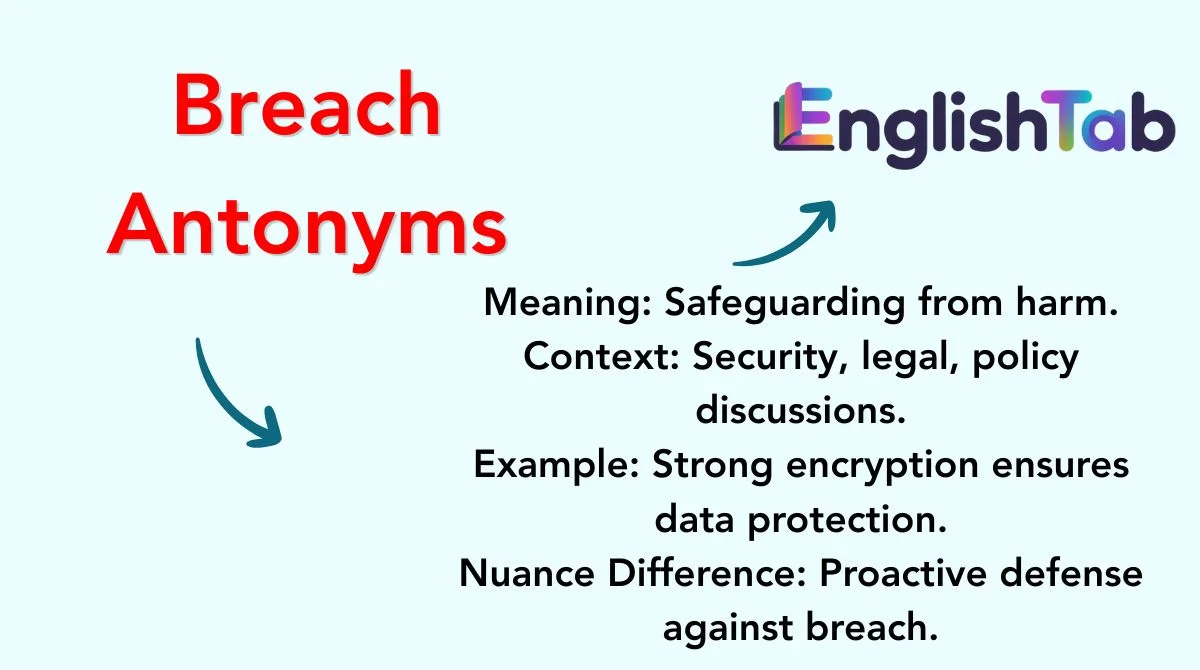
Protection
Meaning: Safeguarding from harm.
Context: Security, legal, policy discussions.
Example: Strong encryption ensures data protection.
Nuance Difference: Proactive defense against breach.
Safeguard
Meaning: Measure taken to protect.
Context: Risk management.
Example: Financial safeguards prevent system failure.
Nuance Difference: Concrete mechanism rather than abstract principle.
Respect
Meaning: Due regard for rules or persons.
Context: Interpersonal or legal contexts.
Example: Respect for privacy laws prevents violation.
Nuance Difference: Emphasizes attitude rather than action.
Loyalty
Meaning: Faithful allegiance.
Context: Relationships or institutions.
Example: Loyalty to ethical standards builds credibility.
Nuance Difference: Emotional counterpoint to betrayal.
Harmony
Meaning: Peaceful coexistence.
Context: Social or diplomatic contexts.
Example: The treaty restored harmony between nations.
Nuance Difference: Emotional and relational contrast.
Unity
Meaning: Oneness and cohesion.
Context: Group dynamics.
Example: Unity prevented internal conflict.
Nuance Difference: Collective stability versus rupture.
Agreement
Meaning: Mutual understanding or contract.
Context: Legal and diplomatic settings.
Example: The agreement was honored fully.
Nuance Difference: Precondition opposite to breach of contract.
Security
Meaning: Safety from threat.
Context: Technology and law.
Example: Strong passwords maintain security.
Nuance Difference: State of protection, not action.
Defense
Meaning: Protection against attack.
Context: Military or cybersecurity writing.
Example: Robust defense systems blocked intrusion.
Nuance Difference: Active resistance against breach.
Maintenance
Meaning: Keeping something in good condition.
Context: Technical or institutional writing.
Example: Regular maintenance prevents structural failure.
Nuance Difference: Preventative stability.
Preservation
Meaning: Protecting from damage.
Context: Environmental or archival contexts.
Example: Preservation efforts safeguarded historical records.
Nuance Difference: Long-term protection.
Honor
Meaning: Fulfilling commitments faithfully.
Context: Contracts and promises.
Example: The company honored its warranty.
Nuance Difference: Ethical dimension stronger than compliance.
Antonym Comparison Table
| Antonym | Primary Context | Focus | Emotional Tone | Formality Level |
|---|---|---|---|---|
| Compliance | Legal/Regulatory | Obedience | Neutral | High |
| Integrity | Ethical/Structural | Wholeness | Positive | High |
| Loyalty | Relational | Faithfulness | Warm | Medium |
| Protection | Security | Defense | Neutral | Medium |
| Agreement | Contractual | Mutual consent | Neutral | High |
| Harmony | Social/Diplomatic | Peace | Positive | Medium |
| Fulfillment | Contractual | Completion | Positive | High |
| Preservation | Environmental | Safeguarding | Neutral | High |
Academic Writing Examples
- Instead of stating a breach occurred, scholars may note a failure of compliance.
- The study maintained data integrity throughout analysis.
- Observance of ethical guidelines prevented misconduct.
- Fulfillment of contractual duties strengthened institutional trust.
- Preservation of evidence ensured procedural fairness.
Each substitution must align with context.
When Not to Replace the Word
Avoid replacing breach when:
- Referring to legal terminology (breach of contract is precise).
- Citing statutes or case law.
- Using established phrases (security breach).
- Describing physical rupture (dam breach).
Over-replacement can weaken precision.
Practice Exercises
- Replace breach with a suitable antonym:
The organization avoided a data breach through strict ______. - Identify best antonym:
Breach of trust vs ______ of trust. - Rewrite sentence using opposite meaning:
The company breached the agreement. - Choose tone-based antonym:
The breach caused hostility; the new treaty restored ______. - Select contextual opposite:
The wall suffered a breach; engineers performed immediate ______.
FAQs
What is the strongest antonym of breach?
Compliance or adherence in legal contexts; integrity in ethical contexts.
Is integrity always the opposite of breach?
Not always. Integrity contrasts moral violation, but structural breaches may require protection or repair.
Can harmony replace breach?
Only in relational contexts where emotional rupture is implied.
What is the legal opposite of breach?
Fulfillment or performance of contract.
Is repair an antonym?
Repair is reactive; it restores after breach but does not prevent it.
Conclusion
The word breach signifies rupture—of law, trust, structure, or peace. Its antonyms represent preservation, loyalty, integrity, and compliance.
Effective writers do not merely replace words; they select contrasts that sharpen meaning and preserve nuance.
Understanding 17+ breach antonyms empowers academic, legal, and professional writers to communicate with greater clarity, precision, and authority. Mastery of opposites is mastery of definition itself.

Dorian Hale is an English language enthusiast and content creator dedicated to making vocabulary and grammar learning simple, engaging, and accessible for everyone.