In academic and professional writing, precision depends not only on choosing the right word but also on understanding its opposite.
Opposites sharpen meaning. They create contrast. They define boundaries. When a writer understands antonyms deeply, arguments become clearer and analysis becomes stronger.
The word bond carries emotional, social, legal, financial, and even chemical meanings. Because of its layered usage, identifying its antonyms requires careful contextual evaluation.
A “bond” may refer to emotional attachment, legal obligation, financial security, physical connection, or social unity. Each meaning generates a different kind of opposite.
This article presents 21+ bond antonyms, analyzed with academic depth.
You will find direct contrasts, contextual opposites, emotional opposites, detailed explanations, comparison tables, writing examples, and exercises — all structured for clarity and authority.
Definition and Core Meaning of “Bond”
The word bond functions as both a noun and a verb.
As a noun, it may mean:
- A connection or tie between people
- A sense of unity or attachment
- A legal or financial agreement
- A physical or chemical link
As a verb, it means:
- To connect or join
- To form a relationship
- To unite emotionally or socially
At its core, bond implies connection, attachment, unity, obligation, or cohesion.
Therefore, its antonyms generally express:
- Separation
- Division
- Isolation
- Detachment
- Conflict
- Release
- Disintegration
The correct antonym depends entirely on context.
Direct Opposites (Clear Contrasts)
Below are the strongest and most direct antonyms of bond across major meanings:
Separation
Division
Detachment
Disconnection
Isolation
Alienation
Break
Rupture
Split
Fragmentation
Dissolution
Disunion
Conflict
Discord
Hostility
Estrangement
Release
Freedom
Independence
Disintegration
Repulsion
Abandonment
These words present clear, high-contrast oppositions to connection, unity, and attachment.
Contextual Opposites
Some words function as antonyms only in specific contexts.
For example:
- Freedom opposes bond when the word refers to obligation or legal restraint.
- Repulsion opposes bond in chemistry or attraction contexts.
- Independence contrasts with emotional or social bonding.
- Neutrality may oppose bonding in diplomatic alliances.
- Withdrawal contrasts with bonding in relational development.
Understanding context prevents misuse. An emotional bond cannot logically be replaced with financial terms, and a chemical bond cannot be opposed with psychological vocabulary.
Emotional & Tone-Based Opposites
When bond refers to affection or unity, the emotional opposites become more nuanced.
Bond implies:
- Warmth
- Trust
- Loyalty
- Unity
- Mutual support
Emotional antonyms include:
- Alienation (emotional distance)
- Hostility (active opposition)
- Estrangement (broken relationship)
- Coldness (lack of warmth)
- Indifference (absence of emotional attachment)
These words differ in intensity. Coldness suggests emotional reduction, while hostility implies active negativity.
21+ Antonyms Explained in Detail
Below are detailed analyses of more than twenty bond antonyms.
Separation
Meaning: The act of moving apart or keeping apart.
Context: Used in relationships, organizations, or physical structures.
Example: The separation of the two departments reduced collaboration.
Nuance: Neutral in tone; does not necessarily imply conflict.
Division
Meaning: The state of being split into parts.
Context: Social, political, organizational settings.
Example: Political division weakened the nation’s unity.
Nuance: Often implies structural or ideological splitting.
Detachment
Meaning: Emotional distance or lack of involvement.
Context: Psychological or relational contexts.
Example: His detachment prevented meaningful friendships.
Nuance: Suggests emotional withdrawal rather than conflict.
Disconnection
Meaning: Lack of connection or relationship.
Context: Technology, relationships, communication.
Example: Disconnection between leaders and citizens creates instability.
Nuance: Can be temporary or systemic.
Isolation
Meaning: Being alone or separated from others.
Context: Social, psychological, geographical.
Example: Prolonged isolation can harm mental health.
Nuance: Implies loneliness or physical removal.
Alienation
Meaning: Emotional estrangement or social exclusion.
Context: Social psychology and sociology.
Example: Workplace alienation reduces productivity.
Nuance: Suggests deep emotional separation.
Break
Meaning: A disruption in continuity.
Context: Relationships, contracts, materials.
Example: A break in communication ended the partnership.
Nuance: Often sudden and noticeable.
Rupture
Meaning: A violent or dramatic break.
Context: Medical, relational, diplomatic contexts.
Example: The scandal caused a rupture in public trust.
Nuance: Stronger and more dramatic than break.
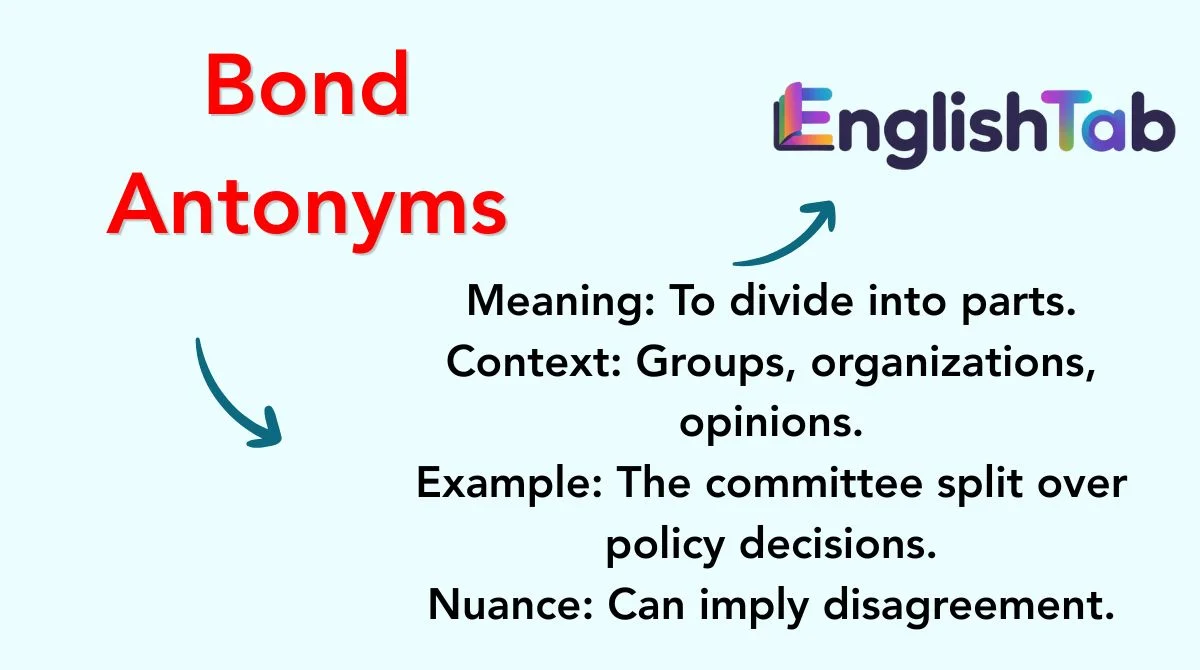
Split
Meaning: To divide into parts.
Context: Groups, organizations, opinions.
Example: The committee split over policy decisions.
Nuance: Can imply disagreement.
Fragmentation
Meaning: Breaking into smaller pieces.
Context: Social structures, political systems.
Example: Cultural fragmentation weakens shared identity.
Nuance: Suggests loss of cohesion.
Dissolution
Meaning: Formal ending or termination.
Context: Legal or institutional contexts.
Example: The dissolution of the alliance changed global politics.
Nuance: Often official and procedural.
Disunion
Meaning: Lack of unity.
Context: Political or social groups.
Example: Disunion among members delayed progress.
Nuance: Focuses on absence of harmony.
Conflict
Meaning: Active disagreement or struggle.
Context: Personal, social, military.
Example: Conflict replaced the former bond of friendship.
Nuance: Opposes unity through confrontation.
Discord
Meaning: Lack of agreement or harmony.
Context: Social and relational settings.
Example: Discord within the team reduced efficiency.
Nuance: Less intense than conflict.
Hostility
Meaning: Open aggression or opposition.
Context: Emotional and diplomatic contexts.
Example: Hostility replaced cooperation.
Nuance: Emotionally charged opposite.
Estrangement
Meaning: The state of being no longer close.
Context: Family and personal relationships.
Example: Years of silence led to estrangement.
Nuance: Slow emotional separation.
Release
Meaning: Freedom from restraint.
Context: Legal or financial bond.
Example: The prisoner’s release ended his legal bond.
Nuance: Positive tone in contrast to obligation.
Freedom
Meaning: Absence of control or obligation.
Context: Legal, political, emotional.
Example: Freedom replaces forced loyalty.
Nuance: Not always negative; depends on context.
Independence
Meaning: Self-reliance without reliance on others.
Context: Personal growth, politics.
Example: Independence may reduce reliance bonds.
Nuance: Positive but opposite of attachment.
Disintegration
Meaning: Breakdown into parts.
Context: Social or physical systems.
Example: Social disintegration weakens communities.
Nuance: Gradual collapse.
Repulsion
Meaning: Force pushing away.
Context: Physics or emotional reaction.
Example: Emotional repulsion prevented connection.
Nuance: Active rejection.
Abandonment
Meaning: Leaving behind completely.
Context: Personal relationships.
Example: Abandonment destroys emotional bonds.
Nuance: Suggests betrayal or neglect.
Antonym Comparison Table
Word | Emotional Intensity | Formal Use | Suggests Conflict | Implies Permanence
Separation | Low | Yes | No | Sometimes
Division | Medium | Yes | Sometimes | No
Alienation | High | Yes | No | Often
Conflict | High | Yes | Yes | No
Estrangement | Medium | Yes | No | Often
Isolation | Medium | Yes | No | Sometimes
Rupture | Very High | Yes | Yes | Often
Freedom | Low | Yes | No | No
Disintegration | High | Yes | No | Often
This table highlights contextual variation rather than fixed opposition.
Academic Writing Examples
- The bond between citizens and institutions weakens when alienation increases.
- Social fragmentation can replace national unity.
- Emotional detachment prevents long-term relational stability.
- Political division disrupts democratic cohesion.
- Institutional dissolution marks the end of cooperative frameworks.
In academic writing, replacing bond with the correct antonym increases analytical precision.
When Not to Replace the Word
Do not replace bond when:
- The text refers to financial securities unless discussing release or default.
- The meaning involves chemical bonding without scientific opposites.
- The tone requires neutrality.
- The original word conveys balanced attachment rather than extreme unity.
Unnecessary substitution can distort meaning.
Practice Exercises
- Replace “bond” with a suitable antonym:
The emotional bond turned into ______ after years of disagreement. - Choose the stronger antonym:
rupture or separation? - Write a sentence contrasting bond and alienation.
- Identify the most appropriate antonym in legal context.
- Compare independence and isolation in two sentences.
FAQs
What is the strongest antonym of bond?
Rupture or disintegration are among the strongest, depending on context.
Is freedom always an antonym of bond?
Only when bond refers to obligation or restraint.
What is the emotional opposite of bond?
Alienation, estrangement, or hostility.
Can conflict replace bond in writing?
Yes, when highlighting contrast between unity and opposition.
Are all antonyms negative?
No. Independence and freedom may carry positive meaning.
Conclusion
Understanding 21+ bond antonyms requires contextual awareness, emotional sensitivity, and academic precision.
The word bond represents connection and unity in multiple domains. Its opposites range from mild separation to intense rupture.
Writers who master these contrasts gain sharper clarity, stronger argumentation, and improved stylistic control.
Whether discussing social cohesion, emotional attachment, or legal obligation, choosing the correct antonym transforms analysis from basic to authoritative.
Precision is power. Contrast is clarity. And language, when used thoughtfully, defines meaning at its highest level.
SEO Meta Description

Dorian Hale is an English language enthusiast and content creator dedicated to making vocabulary and grammar learning simple, engaging, and accessible for everyone.