In academic writing, clarity often depends not only on defining a concept but also on understanding what it is not. Opposites sharpen meaning. They create boundaries.
They prevent ambiguity. When a researcher writes about biodiversity, readers grasp the concept more fully when they also understand its contrast—decline, uniformity, simplification, or ecological collapse.
Using antonyms strategically improves analytical depth.
In environmental science, policy writing, sustainability debates, and academic discourse, contrasting biodiversity with its opposites allows for stronger arguments, clearer interpretation of data, and more persuasive conclusions.
This article explores 24+ biodiversity antonyms in depth. Each term is carefully explained, compared, and contextualized to support professional, academic, and research-based writing.
Definition and Core Meaning of “Biodiversity”
Biodiversity refers to the variety and variability of life on Earth. It includes diversity at three major levels:
- Genetic diversity (variation within species)
- Species diversity (variety of species)
- Ecosystem diversity (variety of habitats and ecological systems)
The term was popularized in scientific and policy discussions following the 1992 Earth Summit in Rio and remains central to frameworks like the United Nations Environment Programme.
At its core, biodiversity implies:
- Richness
- Variety
- Complexity
- Ecological balance
- Interdependence
Its antonyms therefore express loss, uniformity, reduction, simplification, or ecological degradation.
Direct Opposites (Clear Contrasts)
The following are the strongest direct biodiversity antonyms, representing structural ecological contrasts:
Uniformity
Homogeneity
Monoculture
Ecological collapse
Extinction
Species loss
Depopulation
Depletion
Reduction
Simplification
Degradation
Imbalance
Sterility
Barreness
Desolation
Deforestation
Desertification
Fragmentation
Overexploitation
Contamination
Pollution
Habitat destruction
Biotic erosion
Genetic erosion
These terms oppose biodiversity in structural, ecological, or systemic ways.
Contextual Opposites
Some words oppose biodiversity depending on context:
Standardization
Industrialization
Urban sprawl
Overdevelopment
Artificiality
Sterilization
Domestication
Isolation
Consolidation
Intensification
For example, industrialization does not automatically eliminate biodiversity, but uncontrolled industrial expansion often reduces ecological diversity.
Emotional & Tone-Based Opposites
Certain antonyms carry emotional weight rather than purely scientific contrast:
Devastation
Collapse
Ruin
Wasteland
Lifelessness
Decay
Bleakness
Emptiness
These terms intensify environmental decline rhetorically, especially in advocacy or policy speeches.
24+ Antonyms Explained in Detail
Below are 24 carefully analyzed biodiversity antonyms.
Uniformity
Meaning: Lack of variation or diversity.
Context: Used when ecosystems become standardized.
Example: Large-scale monoculture farming promotes ecological uniformity.
Nuance: Uniformity emphasizes sameness, not necessarily total loss of life.
Homogeneity
Meaning: Structural similarity within a system.
Context: Biological communities dominated by few similar species.
Example: Urban lawns create ecological homogeneity.
Nuance: More technical than uniformity; often used in scientific literature.
Monoculture
Meaning: Cultivation of a single crop or species.
Context: Agricultural systems replacing diverse habitats.
Example: Palm oil plantations represent monoculture landscapes.
Nuance: Agricultural-specific; implies economic motive.
Ecological Collapse
Meaning: Complete breakdown of ecosystem function.
Context: Overfishing leading to marine collapse.
Example: Coral bleaching may trigger ecological collapse.
Nuance: Implies systemic failure, not gradual decline.
Extinction
Meaning: Permanent disappearance of a species.
Context: Species loss at global scale.
Example: The dodo became extinct due to human activity.
Nuance: Absolute and irreversible.
Species Loss
Meaning: Decline in number of species.
Context: Measured in biodiversity indices.
Example: Tropical forests face severe species loss.
Nuance: Broader than extinction; includes local disappearance.
Depopulation
Meaning: Reduction in population numbers.
Context: Wildlife population decline.
Example: Overhunting causes depopulation of large mammals.
Nuance: Refers to quantity, not variety.
Depletion
Meaning: Gradual reduction of resources.
Context: Soil nutrient depletion affecting biodiversity.
Example: Overgrazing leads to ecosystem depletion.
Nuance: Often slow and cumulative.
Reduction
Meaning: Decrease in size or amount.
Context: Habitat reduction impacts diversity.
Example: Wetland reduction harms amphibian species.
Nuance: Neutral tone compared to extinction.
Simplification
Meaning: Decrease in ecological complexity.
Context: Loss of trophic levels.
Example: River channelization causes ecological simplification.
Nuance: Focuses on structural complexity.
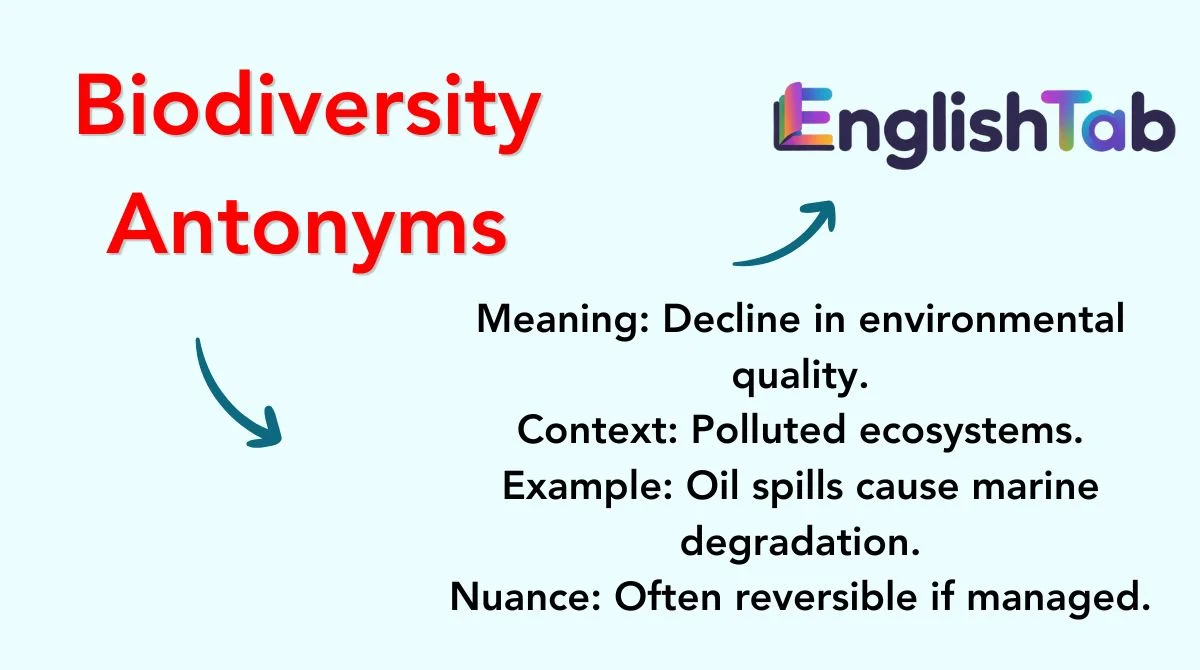
Degradation
Meaning: Decline in environmental quality.
Context: Polluted ecosystems.
Example: Oil spills cause marine degradation.
Nuance: Often reversible if managed.
Imbalance
Meaning: Disruption of ecological equilibrium.
Context: Predator removal altering food webs.
Example: Imbalance leads to invasive species spread.
Nuance: Suggests functional instability.
Sterility
Meaning: Inability to support life.
Context: Toxic soils.
Example: Heavy metals create soil sterility.
Nuance: Implies extreme biological absence.
Barreness
Meaning: Lack of vegetation or life.
Context: Desertified landscapes.
Example: Mining leaves behind barrenness.
Nuance: Descriptive and visual.
Desolation
Meaning: Emotional and physical emptiness.
Context: Environmental destruction.
Example: Forest fires leave desolation.
Nuance: More poetic than scientific.
Deforestation
Meaning: Clearing of forests.
Context: Major biodiversity threat.
Example: Amazon deforestation reduces species richness.
Nuance: Specific process rather than condition.
Desertification
Meaning: Land degradation in dry areas.
Context: Climate-induced ecosystem change.
Example: Overgrazing accelerates desertification.
Nuance: Climate-linked process.
Fragmentation
Meaning: Breaking habitats into smaller patches.
Context: Road construction.
Example: Habitat fragmentation isolates species.
Nuance: Impacts genetic diversity.
Overexploitation
Meaning: Excessive resource use.
Context: Fishing, logging.
Example: Overexploitation threatens marine diversity.
Nuance: Human-driven cause.
Contamination
Meaning: Introduction of harmful substances.
Context: Chemical runoff.
Example: Water contamination reduces aquatic life.
Nuance: Specific to pollutants.
Pollution
Meaning: Environmental impurity.
Context: Air, soil, water pollution.
Example: Industrial pollution kills river species.
Nuance: Broader than contamination.
Habitat Destruction
Meaning: Elimination of living space.
Context: Urban development.
Example: Highway expansion causes habitat destruction.
Nuance: Direct biodiversity threat.
Biotic Erosion
Meaning: Loss of living components.
Context: Ecological decline.
Example: Biotic erosion weakens ecosystem resilience.
Nuance: Academic term.
Genetic Erosion
Meaning: Loss of genetic variation.
Context: Crop uniformity.
Example: Genetic erosion threatens food security.
Nuance: Focuses on micro-level diversity.
Antonym Comparison Table
| Term | Severity Level | Reversibility | Scope | Emotional Tone |
|---|---|---|---|---|
| Extinction | Extreme | No | Species | Neutral-scientific |
| Degradation | Moderate | Often yes | Ecosystem | Technical |
| Desolation | High | Sometimes | Landscape | Emotional |
| Uniformity | Low-Moderate | Yes | Structural | Neutral |
| Fragmentation | Moderate | Difficult | Habitat | Analytical |
| Desertification | High | Limited | Regional | Scientific |
| Pollution | Variable | Possible | Environmental | Neutral |
| Ecological Collapse | Extreme | Rare | System-wide | Alarmist |
| Monoculture | Moderate | Yes | Agricultural | Technical |
Academic Writing Examples
- Biodiversity enhances ecosystem resilience, whereas monoculture systems increase vulnerability to disease.
- The expansion of industrial agriculture has led to ecological simplification and genetic erosion.
- While biodiversity supports ecosystem stability, fragmentation undermines species interaction networks.
- Climate change accelerates desertification, contributing to habitat destruction and species loss.
- Marine biodiversity contrasts sharply with ecological collapse caused by overexploitation.
When Not to Replace the Word
Avoid replacing biodiversity when:
- Writing formal ecological definitions
- Referring to legal or treaty language
- Citing global frameworks such as the Convention on Biological Diversity
- Presenting quantitative biodiversity indices
Substituting with emotional antonyms like devastation may weaken scientific neutrality.
Practice Exercises
- Replace biodiversity with an appropriate antonym in this sentence:
“Intensive farming reduces ______ in rural landscapes.” - Identify whether fragmentation or degradation better contrasts biodiversity in urban ecosystems.
- Write a comparative sentence using biodiversity and ecological collapse.
- Explain the difference between genetic erosion and species loss.
- Analyze which antonym best fits coral reef bleaching.
FAQs
What is the strongest antonym of biodiversity?
Extinction is the strongest absolute opposite because it represents complete and irreversible species loss.
Is monoculture always the opposite of biodiversity?
Not entirely. It is an agricultural contrast, but biodiversity can exist at small scales even within monoculture regions.
Does pollution equal biodiversity loss?
Pollution often leads to biodiversity loss, but the terms are not identical. Pollution is a cause; biodiversity loss is a result.
Can degradation be reversed?
In many cases, yes. Restoration ecology can rebuild degraded ecosystems.
Is uniformity less severe than extinction?
Yes. Uniformity implies sameness, while extinction implies permanent disappearance.
Conclusion
Understanding biodiversity antonyms strengthens ecological analysis, academic precision, and persuasive environmental writing.
These opposites reveal the structural, functional, and emotional contrasts necessary for deep environmental discourse.
From uniformity to ecological collapse, each antonym reflects a different dimension of decline. Some describe causes. Others describe outcomes.
Some are scientific. Others are rhetorical. Together, they map the conceptual boundaries of biodiversity.
Mastering these contrasts equips writers, researchers, and students to express environmental realities with greater clarity, accuracy, and authority in 2026 and beyond.

Dorian Hale is an English language enthusiast and content creator dedicated to making vocabulary and grammar learning simple, engaging, and accessible for everyone.