Strong writing depends on contrast. When readers understand what something is not, they better understand what it is. This is why antonyms matter.
Opposites sharpen meaning, reduce confusion, and create clarity in academic, creative, and professional writing.
The word bewilderment describes a state of confusion, mental fog, or emotional uncertainty. While it is a powerful term, overusing it can weaken expression.
Writers must know when to replace it with a stronger contrast—especially when clarity, logic, or emotional control is required.
In this in-depth guide, you will discover 21+ bewilderment antonyms, explained with meaning, context, examples, and nuance differences.
Each term is carefully analyzed to help you choose the most precise word for your writing in 2026 and beyond.
Definition and Core Meaning of “Bewilderment”
Bewilderment is a noun that describes:
- A state of confusion
- Mental disorientation
- Emotional uncertainty
- Inability to understand what is happening
It often suggests sudden confusion, surprise, or lack of clarity. It can be intellectual (“I don’t understand the concept”) or emotional (“I don’t understand what just happened”).
Core elements of bewilderment:
- Lack of clarity
- Mental overload
- Disorientation
- Emotional surprise
Understanding these core elements makes it easier to identify strong opposites.
Direct Opposites (Clear Contrasts)
The strongest antonyms directly remove confusion and replace it with certainty or understanding.
Here are 21 powerful direct antonyms of bewilderment:
- Clarity
- Understanding
- Comprehension
- Certainty
- Assurance
- Confidence
- Awareness
- Insight
- Knowledge
- Lucidity
- Enlightenment
- Recognition
- Realization
- Surety
- Conviction
- Order
- Direction
- Calm
- Focus
- Control
- Stability
- Assurance
These words remove mental fog and replace it with mental organization or emotional steadiness.
Contextual Opposites
Some words function as antonyms only in certain contexts.
For example:
- Organization opposes bewilderment when confusion comes from chaos.
- Preparation opposes bewilderment when confusion results from being unready.
- Guidance opposes bewilderment when confusion comes from lack of direction.
- Logic opposes bewilderment in analytical writing.
- Structure opposes bewilderment in academic essays.
These are not pure emotional opposites but situational contrasts.
Emotional & Tone-Based Opposites
Bewilderment often carries emotional intensity. Therefore, its antonyms may differ in emotional tone.
- Calm removes emotional panic.
- Confidence removes self-doubt.
- Certainty removes hesitation.
- Enlightenment suggests a breakthrough.
- Control suggests authority over chaos.
Each word shifts tone differently. “Clarity” sounds neutral. “Conviction” sounds strong and assertive. “Lucidity” sounds intellectual. Emotional intensity matters in academic writing.
21+ Antonyms Explained in Detail
Below are detailed explanations of the strongest antonyms.
Clarity
Meaning: The quality of being clear and easy to understand.
Context: Used when information becomes understandable.
Example: After the explanation, she felt clarity instead of confusion.
Nuance: Clarity focuses on sharp thinking, not emotional strength.
Understanding
Meaning: The ability to grasp meaning.
Context: Academic or interpersonal discussions.
Example: The teacher’s example brought understanding.
Nuance: More relational and softer than “comprehension.”
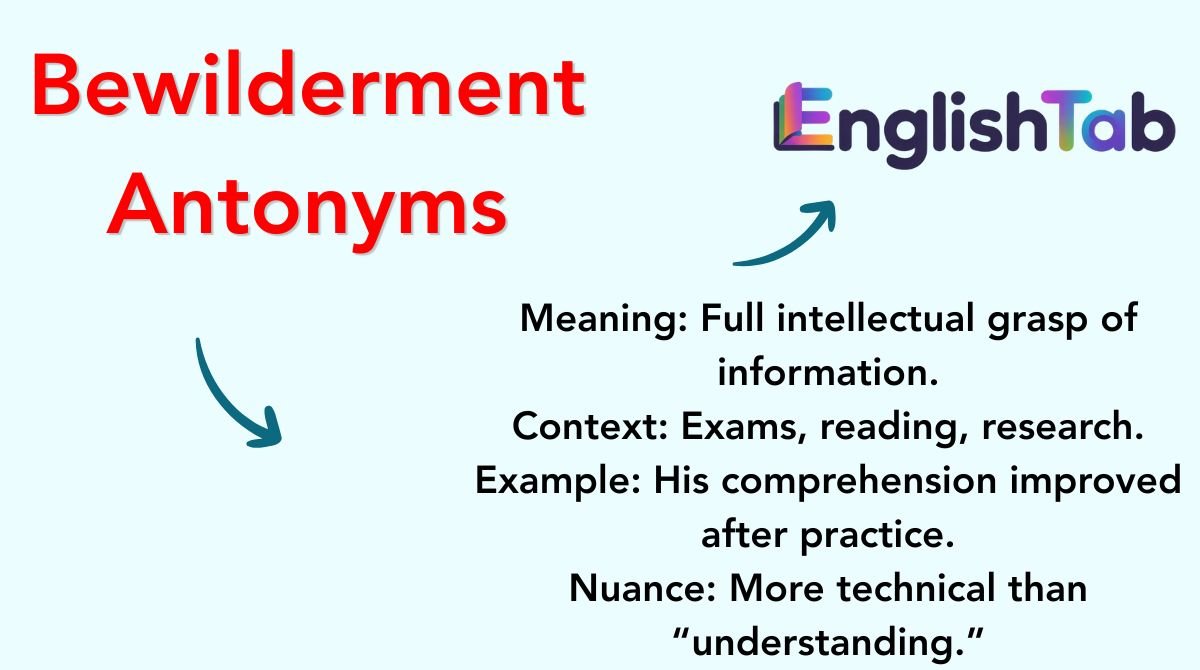
Comprehension
Meaning: Full intellectual grasp of information.
Context: Exams, reading, research.
Example: His comprehension improved after practice.
Nuance: More technical than “understanding.”
Certainty
Meaning: Complete absence of doubt.
Context: Logical or factual situations.
Example: She answered with certainty.
Nuance: Stronger than clarity because it removes doubt.
Assurance
Meaning: A feeling of confidence or guarantee.
Context: Emotional reassurance.
Example: His voice gave assurance.
Nuance: Emotional comfort, not just mental clarity.
Confidence
Meaning: Trust in one’s ability or knowledge.
Context: Public speaking, decisions.
Example: He spoke with confidence.
Nuance: Self-focused strength.
Awareness
Meaning: Conscious knowledge of something.
Context: Social or intellectual growth.
Example: Awareness replaced confusion.
Nuance: First stage before deeper understanding.
Insight
Meaning: Deep understanding of a complex issue.
Context: Analytical essays.
Example: The research provided insight.
Nuance: Suggests depth and intelligence.
Knowledge
Meaning: Information and understanding gained through learning.
Context: Academic writing.
Example: Knowledge removes confusion.
Nuance: Broader than comprehension.
Lucidity
Meaning: Clear expression or thinking.
Context: Formal or literary writing.
Example: Her lucidity impressed the panel.
Nuance: Elegant and intellectual.
Enlightenment
Meaning: Gaining higher understanding.
Context: Philosophical or spiritual writing.
Example: The lecture brought enlightenment.
Nuance: Suggests transformation.
Recognition
Meaning: Identifying something known.
Context: Memory or familiarity.
Example: Recognition replaced puzzlement.
Nuance: Specific rather than broad.
Realization
Meaning: Becoming aware of something suddenly.
Context: Narrative writing.
Example: Realization ended his confusion.
Nuance: Often sudden.
Surety
Meaning: Complete confidence or guarantee.
Context: Formal writing.
Example: She acted with surety.
Nuance: Slightly stronger and more formal than certainty.
Conviction
Meaning: Strong belief or opinion.
Context: Persuasive writing.
Example: He argued with conviction.
Nuance: Emotionally powerful.
Order
Meaning: Organized structure.
Context: When confusion comes from chaos.
Example: Order replaced disorder.
Nuance: External structure rather than internal clarity.
Direction
Meaning: Clear path forward.
Context: Planning or leadership.
Example: The leader gave direction.
Nuance: Action-oriented opposite.
Calm
Meaning: Peaceful emotional state.
Context: Stress situations.
Example: Calm overcame panic.
Nuance: Emotional, not intellectual.
Focus
Meaning: Concentrated attention.
Context: Productivity or study.
Example: Focus replaced distraction.
Nuance: Active mental control.
Control
Meaning: Power over situation or emotions.
Context: Leadership or self-regulation.
Example: She regained control.
Nuance: Authority-driven.
Stability
Meaning: Steady and balanced condition.
Context: Emotional or structural writing.
Example: Stability replaced uncertainty.
Nuance: Long-term steadiness.
Preparation
Meaning: Being ready beforehand.
Context: Exams, speeches.
Example: Preparation prevented confusion.
Nuance: Preventive opposite.
Antonym Comparison Table
| Word | Emotional Strength | Intellectual Depth | Formality Level | Best Used In |
|---|---|---|---|---|
| Clarity | Medium | Medium | Neutral | General writing |
| Comprehension | Low | High | Academic | Exams, research |
| Certainty | High | Medium | Formal | Arguments |
| Confidence | High | Low | Neutral | Public speaking |
| Insight | Medium | Very High | Academic | Analysis |
| Lucidity | Low | High | Formal | Essays |
| Calm | Emotional | Low | Neutral | Narratives |
| Conviction | Very High | Medium | Persuasive | Debates |
| Enlightenment | High | High | Literary | Philosophy |
Academic Writing Examples
- Instead of saying:
“The results caused bewilderment among researchers.” You may write:
“The results initially caused confusion, but further analysis provided clarity.” - Instead of:
“Students expressed bewilderment about the theory.” Write:
“Students lacked comprehension of the theoretical framework.” - Instead of:
“The speech left the audience in bewilderment.” Write:
“The speech failed to provide sufficient explanation or direction.”
Academic writing values precision over emotion.
When Not to Replace the Word
Do not replace bewilderment when:
- You want to emphasize emotional shock.
- The confusion is sudden and dramatic.
- Narrative tone requires intensity.
- The character’s reaction must feel chaotic.
Replacing it with “lack of understanding” may weaken emotional impact.
Practice Exercises
Fill in the blanks with the best antonym:
- After the explanation, her ______ replaced confusion.
- The scientist spoke with complete ______ about the results.
- Meditation brought emotional ______ during crisis.
- His deep ______ of history impressed the professor.
- Clear instructions gave students a sense of ______.
Answer key:
- clarity
- certainty
- calm
- knowledge or insight
- direction
FAQs
What is the strongest antonym of bewilderment?
The strongest antonym depends on context. For intellectual confusion, comprehension or clarity works best. For emotional confusion, calm or confidence may be stronger.
Is clarity the same as certainty?
No. Clarity removes confusion, but certainty removes doubt. You can understand something clearly and still feel uncertain about it.
Which antonym is best for academic writing?
Comprehension, insight, lucidity, and clarity are strongest in academic contexts.
Can confidence replace bewilderment?
Yes, when confusion relates to self-doubt rather than lack of knowledge.
Conclusion
Understanding 21+ bewilderment antonyms strengthens writing precision.
Whether you choose clarity, certainty, insight, or conviction, each word shifts tone, emotional intensity, and intellectual depth.
Strong writers do not rely on one emotional term. They analyze context. They choose the exact opposite needed. They understand nuance.
Mastering these antonyms ensures that your academic, professional, and creative writing remains sharp, controlled, and authoritative in 2026 and beyond.

Dorian Hale is an English language enthusiast and content creator dedicated to making vocabulary and grammar learning simple, engaging, and accessible for everyone.