Precision in language is not only about choosing the right word—it is also about understanding its opposite. Opposites sharpen meaning. They create contrast. They clarify tone.
In academic, creative, and professional writing, selecting the correct antonym can dramatically shift emotional weight and interpretive nuance.
The word bereft carries deep emotional and contextual intensity. It suggests loss, deprivation, or absence—often with a tone of sorrow or emptiness. To understand it fully, writers must explore its strongest opposites.
Doing so enhances vocabulary range, analytical skill, and expressive clarity.
This comprehensive guide explores 17+ powerful bereft antonyms, their subtle differences, contextual uses, academic applications, and situations where replacement may or may not be appropriate.
Definition and Core Meaning of “Bereft”
The adjective bereft means:
- Deprived of something
- Lacking something essential
- Emptied through loss
- Often emotionally affected by that absence
The word frequently appears in emotionally charged contexts:
- Bereft of hope
- Bereft of family
- Bereft of guidance
- Bereft of resources
It implies more than simple absence. It carries emotional depth, suggesting grief, abandonment, or profound lack.
Understanding its antonyms requires examining degrees of presence, fulfillment, support, and abundance.
Direct Opposites (Clear Contrasts)
These antonyms directly counter the idea of deprivation or loss. They represent presence, possession, or fullness.
Complete
Fulfilled
Abundant
Rich
Supplied
Provided
Endowed
Equipped
Supported
Comforted
Satisfied
Whole
Fortunate
Prosperous
Blessed
Enriched
Replete
Each of these words strongly contradicts the condition of being deprived.
Contextual Opposites
Some words oppose bereft only in specific situations. Context determines whether they function as true antonyms.
Connected
Guided
Protected
Empowered
Fortified
Inspired
Strengthened
Resourced
Encouraged
For example, “bereft of guidance” contrasts with “guided,” while “bereft of strength” contrasts with “strengthened.” These opposites depend on the object of deprivation.
Emotional & Tone-Based Opposites
Because bereft carries emotional weight, its opposites must also be evaluated emotionally.
High-intensity emotional opposites:
- Comforted
- Blessed
- Supported
- Enriched
Moderate emotional opposites:
- Supplied
- Provided
- Equipped
Neutral opposites:
- Complete
- Whole
- Replete
A writer choosing between complete and blessed is making a tonal decision. One is structural. The other is emotional.
17+ Antonyms Explained in Detail
Below are detailed explanations of key antonyms, including meaning, context, example, and nuance.
Complete
Meaning: Having all necessary parts; not lacking anything.
Context: Structural or logical fullness.
Example: The report was complete, with no sections missing.
Nuance: Unlike bereft, which implies painful absence, complete focuses on structural wholeness.
Fulfilled
Meaning: Satisfied emotionally or spiritually.
Context: Emotional or personal development.
Example: She felt fulfilled after completing her research.
Nuance: Strong emotional opposite of bereft of purpose or joy.
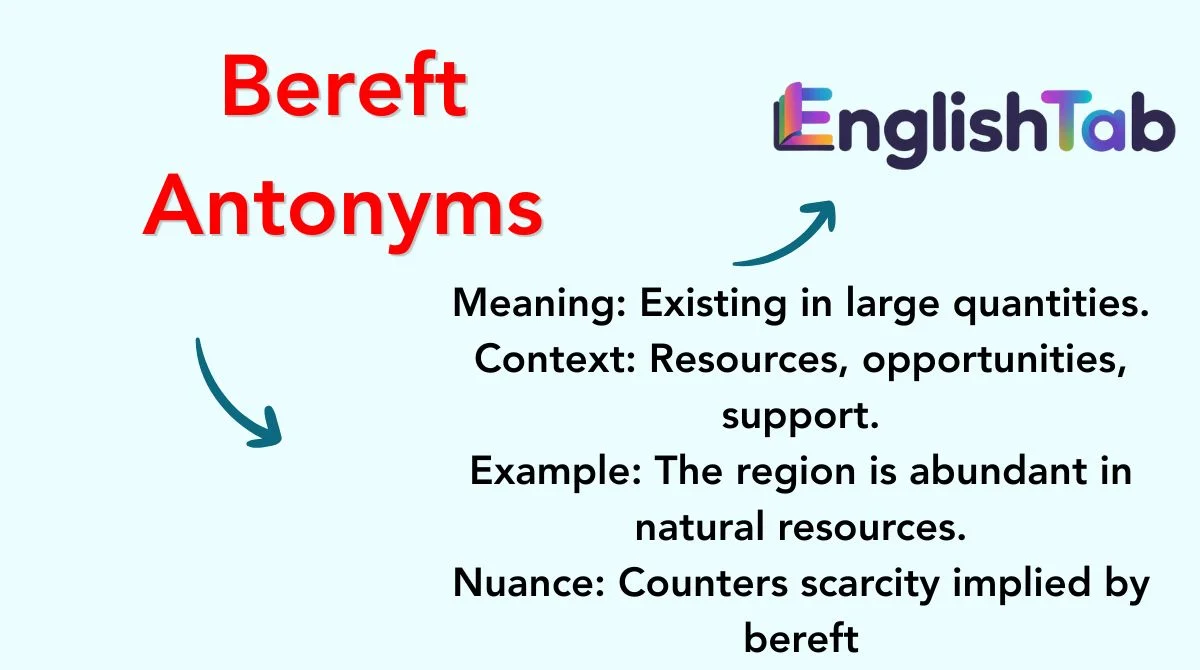
Abundant
Meaning: Existing in large quantities.
Context: Resources, opportunities, support.
Example: The region is abundant in natural resources.
Nuance: Counters scarcity implied by bereft.
Rich
Meaning: Having wealth or plentiful qualities.
Context: Financial, cultural, descriptive.
Example: The soil is rich in nutrients.
Nuance: Suggests value and depth, not just presence.
Supplied
Meaning: Given what is needed.
Context: Logistics, resources.
Example: The students were supplied with necessary materials.
Nuance: Practical opposite of bereft of resources.
Provided
Meaning: Made available.
Context: Formal or instructional writing.
Example: Support was provided during the transition.
Nuance: More neutral than emotional antonyms.
Endowed
Meaning: Naturally gifted or granted qualities.
Context: Talent or institutional resources.
Example: The university is well endowed with research facilities.
Nuance: Implies inherent advantage.
Equipped
Meaning: Prepared with necessary tools.
Context: Skills or materials.
Example: The team was equipped to handle the crisis.
Nuance: Focuses on readiness rather than emotional state.
Supported
Meaning: Given assistance or encouragement.
Context: Emotional, financial, academic.
Example: She felt supported by her peers.
Nuance: Strong emotional counter to bereft of comfort.
Comforted
Meaning: Emotionally soothed.
Context: Grief or distress.
Example: He was comforted by kind words.
Nuance: Direct emotional contrast to bereft of consolation.
Satisfied
Meaning: Content or pleased.
Context: Needs or expectations.
Example: The client was satisfied with the results.
Nuance: Less intense than fulfilled.
Whole
Meaning: Not broken or divided.
Context: Emotional or structural completeness.
Example: The community felt whole again.
Nuance: Suggests restoration after loss.
Fortunate
Meaning: Lucky or favored.
Context: Circumstantial advantage.
Example: She was fortunate to receive mentorship.
Nuance: Opposes deprivation through luck.
Prosperous
Meaning: Financially successful.
Context: Economic discussion.
Example: The once struggling town is now prosperous.
Nuance: Counters economic bereavement.
Blessed
Meaning: Favored with positive circumstances.
Context: Emotional or spiritual tone.
Example: They felt blessed with supportive families.
Nuance: Deep emotional and spiritual opposite.
Enriched
Meaning: Improved in quality or value.
Context: Experience or learning.
Example: Travel enriched her understanding.
Nuance: Opposes emotional emptiness.
Replete
Meaning: Completely filled or supplied.
Context: Academic or formal writing.
Example: The essay was replete with references.
Nuance: Strong, formal opposite of lacking.
Antonym Comparison Table
| Word | Emotional Strength | Formality | Best Used For | Intensity Level |
|---|---|---|---|---|
| Complete | Neutral | High | Structure | Moderate |
| Fulfilled | High | Medium | Personal growth | High |
| Abundant | Medium | Medium | Resources | High |
| Equipped | Neutral | Medium | Preparedness | Moderate |
| Supported | High | Medium | Emotional contexts | High |
| Blessed | Very High | Medium | Spiritual tone | Very High |
| Replete | Neutral | High | Academic writing | High |
| Prosperous | Medium | High | Economics | Moderate |
| Comforted | High | Medium | Grief contexts | High |
Academic Writing Examples
Bereft (Original):
The community was bereft of institutional support.
Revised:
The community was supported by multiple institutional partners.
Bereft (Original):
The theory appears bereft of empirical evidence.
Revised:
The theory is replete with empirical data.
Bereft (Original):
Students felt bereft of guidance.
Revised:
Students were equipped with structured mentorship programs.
These revisions show how tone and analytical clarity shift when antonyms replace emotionally charged wording.
When Not to Replace the Word
Do not replace bereft when:
- You intend to convey grief or tragedy.
- Emotional deprivation is central to the message.
- Literary tone requires intensity.
- The absence is permanent and deeply personal.
For example, “She was bereft after the loss of her child” cannot simply become “She was unsupported.” The emotional gravity differs profoundly.
Practice Exercises
Choose the best antonym for each sentence:
- The region was bereft of economic opportunity.
- The manuscript is bereft of supporting data.
- He felt bereft after the departure of his mentor.
- The facility was bereft of safety equipment.
- The speech was bereft of inspiration.
Rewrite each sentence using an appropriate antonym such as prosperous, replete, supported, equipped, or inspired.
FAQs
What is the strongest antonym of bereft?
It depends on context. In emotional contexts, blessed or comforted may be strongest. In academic contexts, replete or complete may be stronger.
Is rich always an antonym of bereft?
Not always. Rich works when discussing resources, qualities, or abundance—not necessarily emotional loss.
Can fulfilled replace bereft in formal writing?
Yes, especially when discussing psychological or emotional states.
Is replete too formal?
Replete is best used in academic or analytical writing rather than casual speech.
Are all antonyms interchangeable?
No. Tone, intensity, and context determine appropriate substitution.
Conclusion
Understanding bereft antonyms is more than a vocabulary exercise—it is a study in contrast, emotional weight, and contextual precision.
Direct opposites such as complete, abundant, and replete emphasize fullness and presence. Emotional opposites such as blessed and comforted counteract sorrow.
Contextual opposites such as equipped and supported reflect situational correction of absence.
Advanced writers do not simply swap words. They analyze tone, purpose, and audience. By mastering these 17+ antonyms, you expand expressive range and strengthen analytical clarity.
Opposites refine language. Language refines thought. Thought shapes meaning.

Dorian Hale is an English language enthusiast and content creator dedicated to making vocabulary and grammar learning simple, engaging, and accessible for everyone.