Writers often focus on finding better synonyms, yet true clarity emerges when we understand opposites. Antonyms sharpen contrast.
They reveal tone. They control emotional direction. They prevent misunderstanding.
The word banter carries warmth, humor, and informal playfulness.
When you replace it, you do more than change vocabulary — you shift mood, power, and relationship dynamics.
This guide explores 20+ banter antonyms with academic precision and practical depth. You will see how different opposites alter tone, intention, emotional weight, and social context.
By the end, you will understand not only what contrasts with banter — but when and why to use those contrasts effectively.
Definition and Core Meaning of “Banter”
Banter refers to light, playful conversation that often includes teasing or humorous remarks exchanged between people who share comfort or familiarity.
Core elements of banter:
- Informal tone
- Mutual participation
- Humor or wit
- Absence of hostility
- Emotional safety
Banter strengthens relationships. It signals ease. It communicates equality.
Understanding its antonyms requires identifying what banter is not:
- Not hostile
- Not cold
- Not formal
- Not serious
- Not confrontational
Opposites, therefore, will tend to emphasize seriousness, conflict, emotional distance, or formality.
Direct Opposites (Clear Contrasts)
Below are the strongest and clearest antonyms of banter — words that directly oppose its tone and purpose.
Argument
Confrontation
Dispute
Conflict
Hostility
Silence
Formality
Seriousness
Criticism
Reprimand
Accusation
Condemnation
Lecture
Scolding
Denunciation
Complaint
Warning
Threat
Admonishment
Coldness
Each of these removes humor and replaces it with tension, gravity, or emotional distance.
Contextual Opposites
Some words function as antonyms only in specific situations. The contrast depends on tone and social setting.
- Debate (formal and structured rather than playful)
- Negotiation (strategic instead of humorous)
- Interrogation (pressured rather than relaxed)
- Instruction (directive instead of reciprocal)
- Complaint (serious dissatisfaction rather than teasing)
- Critique (analytical instead of playful)
- Silence (absence of exchange)
- Reserve (emotional restraint)
- Professionalism (controlled tone)
In academic and workplace environments, banter may be inappropriate. In those settings, structured or serious communication becomes its contextual opposite.
Emotional & Tone-Based Opposites
Banter is emotionally light. Its opposites tend to intensify emotional weight or remove warmth.
Playful vs Hostile
Lighthearted vs Severe
Warm vs Cold
Casual vs Formal
Affectionate vs Critical
Relaxed vs Tense
Tone-based antonyms are especially important in writing because they shape reader perception instantly.
For example:
“They engaged in banter.”
“They engaged in confrontation.”
The shift changes the emotional landscape completely.
20+ Antonyms Explained in Detail
Below are detailed explanations of key banter antonyms, including meaning, context, examples, and nuance differences.
Argument
Meaning: A disagreement expressed through opposing viewpoints.
Context: Occurs when individuals aim to win or defend a position.
Example: The meeting turned into an argument about budget cuts.
Nuance: Unlike banter, argument seeks resolution or dominance rather than amusement.
Confrontation
Meaning: A direct and often tense encounter.
Context: Used when conflict is unavoidable.
Example: Their playful teasing escalated into confrontation.
Nuance: Banter builds connection; confrontation creates division.
Dispute
Meaning: A formal or prolonged disagreement.
Context: Common in legal or professional situations.
Example: The contract issue led to a dispute.
Nuance: Banter is spontaneous; disputes are sustained and serious.
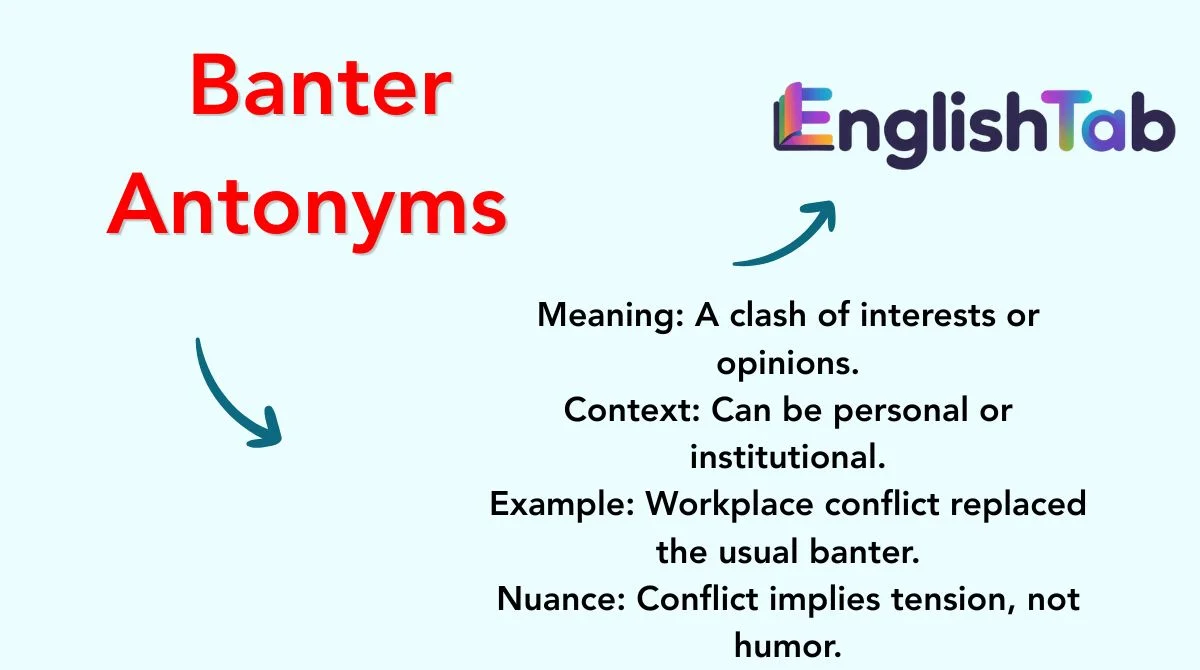
Conflict
Meaning: A clash of interests or opinions.
Context: Can be personal or institutional.
Example: Workplace conflict replaced the usual banter.
Nuance: Conflict implies tension, not humor.
Hostility
Meaning: Open aggression or resentment.
Context: Appears in emotionally charged interactions.
Example: The room filled with hostility.
Nuance: Banter contains goodwill; hostility contains harm.
Silence
Meaning: Absence of speech.
Context: Used intentionally or emotionally.
Example: After the disagreement, silence replaced banter.
Nuance: Banter requires exchange; silence removes it.
Formality
Meaning: Strict adherence to rules or etiquette.
Context: Professional or ceremonial settings.
Example: The courtroom demanded formality.
Nuance: Banter is relaxed; formality is controlled.
Seriousness
Meaning: A tone lacking humor.
Context: Used in high-stakes discussions.
Example: The manager spoke with seriousness.
Nuance: Banter invites laughter; seriousness demands attention.
Criticism
Meaning: Expression of disapproval.
Context: Academic or personal evaluation.
Example: Her remarks sounded like criticism.
Nuance: Banter teases lightly; criticism evaluates firmly.
Reprimand
Meaning: Formal expression of disapproval.
Context: Authority-to-subordinate communication.
Example: The student received a reprimand.
Nuance: Banter suggests equality; reprimand reflects hierarchy.
Accusation
Meaning: Claim that someone did wrong.
Context: Legal or interpersonal blame.
Example: The exchange felt like accusation.
Nuance: Banter implies trust; accusation implies suspicion.
Condemnation
Meaning: Strong public disapproval.
Context: Moral or ethical judgment.
Example: His tone carried condemnation.
Nuance: Banter is forgiving; condemnation is absolute.
Lecture
Meaning: Extended instructive speech.
Context: Academic or disciplinary setting.
Example: Instead of banter, he delivered a lecture.
Nuance: Banter is shared; lecture is one-sided.
Scolding
Meaning: Harsh criticism delivered emotionally.
Context: Often parental or supervisory.
Example: She responded with scolding.
Nuance: Banter amuses; scolding corrects.
Denunciation
Meaning: Public declaration against someone.
Context: Political or ethical condemnation.
Example: The speech became denunciation.
Nuance: Banter builds bonds; denunciation severs them.
Complaint
Meaning: Expression of dissatisfaction.
Context: Consumer or personal context.
Example: His words sounded like complaint.
Nuance: Banter entertains; complaint burdens.
Warning
Meaning: Statement of potential danger.
Context: Preventative communication.
Example: Her tone shifted from banter to warning.
Nuance: Banter invites ease; warning signals risk.
Threat
Meaning: Declaration of intended harm.
Context: Power imbalance situations.
Example: The playful tone turned into threat.
Nuance: Banter relaxes; threat intimidates.
Admonishment
Meaning: Gentle but serious correction.
Context: Moral or professional guidance.
Example: The teacher offered admonishment.
Nuance: Banter may tease; admonishment instructs.
Coldness
Meaning: Emotional detachment.
Context: Relationship strain.
Example: Coldness replaced their usual banter.
Nuance: Banter signals closeness; coldness signals distance.
Antonym Comparison Table
| Word | Emotional Intensity | Formality Level | Relationship Impact | Tone |
|---|---|---|---|---|
| Argument | Medium | Low | Divisive | Defensive |
| Confrontation | High | Medium | Aggressive | Tense |
| Conflict | High | Variable | Strained | Combative |
| Formality | Low | High | Neutral | Controlled |
| Criticism | Medium | Medium | Evaluative | Analytical |
| Reprimand | Medium | High | Hierarchical | Corrective |
| Hostility | Very High | Low | Damaging | Aggressive |
| Silence | Low | Neutral | Distant | Empty |
| Seriousness | Low | Medium | Neutral | Grave |
| Complaint | Medium | Low | Irritated | Negative |
This table illustrates how each antonym differs not only from banter but also from one another.
Academic Writing Examples
Example 1:
Instead of engaging in banter, the participants entered a structured debate that prioritized evidence over humor.
Example 2:
The informal banter common in casual meetings was replaced by strict formality during the legal proceedings.
Example 3:
Where friendly banter once strengthened team morale, rising hostility fractured collaboration.
Example 4:
The professor discouraged banter and encouraged analytical critique during seminar discussions.
Each example demonstrates contextual substitution appropriate for academic tone.
When Not to Replace the Word
Avoid replacing banter when:
- Describing friendly relationships
- Portraying character warmth in fiction
- Highlighting social bonding
- Emphasizing humor
Substituting with harsher antonyms can distort meaning.
For example:
Incorrect: The siblings shared hostility.
Correct: The siblings shared banter.
Precision matters. Not every serious word improves clarity.
Practice Exercises
- Replace banter with a suitable antonym in a courtroom setting.
- Choose the strongest antonym for a workplace disciplinary meeting.
- Identify whether silence or formality better contrasts with banter in a corporate boardroom.
- Write a sentence shifting tone from banter to confrontation.
- Explain why criticism differs from hostility.
These exercises strengthen contextual judgment.
FAQs
What is the strongest antonym of banter?
Hostility and confrontation are among the strongest because they remove humor and introduce tension.
Is silence really an antonym of banter?
Yes. Banter requires exchange. Silence eliminates interaction entirely.
Can seriousness replace banter in formal writing?
Yes. In academic or legal contexts, seriousness is more appropriate.
Is debate an antonym of banter?
Only contextually. Debate may still be friendly but lacks playful tone.
Why is tone important when choosing antonyms?
Tone determines emotional impact. Selecting the wrong antonym can exaggerate or weaken intended meaning.
Conclusion
Understanding 20+ banter antonyms equips writers with tonal precision. Banter represents warmth, playfulness, and social ease.
Its opposites introduce seriousness, distance, hierarchy, or conflict.
Effective writing depends on deliberate contrast. When you replace banter, you reshape emotional atmosphere, power dynamics, and reader interpretation.
Mastery of opposites strengthens clarity. And clarity strengthens authority.

Dorian Hale is an English language enthusiast and content creator dedicated to making vocabulary and grammar learning simple, engaging, and accessible for everyone.