Strong writing depends on contrast. When ideas stand beside their opposites, meaning becomes sharper and more memorable.
One of the most useful ways to improve clarity is to replace weak or overused words with stronger alternatives—or, when needed, with their precise opposites.
The word banal often appears in academic critique, literary analysis, and professional evaluation. It signals a lack of originality.
Yet many writers overuse it or fail to explore the richer vocabulary available to express the opposite idea.
This guide presents 20+ powerful banal antonyms, explains their differences, and demonstrates how they function in academic and professional writing.
You will learn not just what these words mean, but when to use each one for maximum impact.
Definition and Core Meaning of “Banal”
The adjective banal describes something that is overly common, predictable, and lacking originality. It suggests that an idea, statement, or artistic work feels tired because it has been repeated too often.
Core meaning elements:
- Overused
- Clichéd
- Unimaginative
- Lacking freshness
- Predictable
A banal remark does not surprise or stimulate thought. It follows expected patterns without offering new insight.
Example:
The speech was filled with banal statements about success and hard work.
Here, the criticism is not that the speech was wrong, but that it lacked originality.
To understand banal fully, we must now examine its strongest opposites.
Direct Opposites (Clear Contrasts)
These antonyms directly oppose the central idea of banality—lack of originality. Each word below strongly conveys freshness, creativity, or distinctiveness.
Original
Innovative
Creative
Novel
Inventive
Imaginative
Unique
Extraordinary
Remarkable
Exceptional
Groundbreaking
Revolutionary
Distinctive
Fresh
Unconventional
Inspired
Brilliant
Visionary
Trailblazing
Ingenious
These words clearly reject predictability and sameness. They signal originality and intellectual or artistic energy.
Contextual Opposites
Some words oppose banal depending on context rather than strict dictionary meaning. These words may not be direct antonyms, but they contrast with banality in tone or implication.
Provocative
Compelling
Thought-provoking
Complex
Layered
Subtle
Sophisticated
Bold
Striking
Memorable
For example, a statement may not be “innovative,” but if it is thought-provoking, it cannot be considered banal. Context determines opposition.
Emotional & Tone-Based Opposites
Banal suggests emotional flatness. These antonyms focus on intensity, emotional depth, or aesthetic power.
Moving
Powerful
Dramatic
Electrifying
Captivating
Profound
Stirring
Inspiring
Magnetic
Vivid
While banal feels dull, these words imply engagement and emotional force.
20+ Antonyms Explained in Detail
Below are detailed explanations of key antonyms, including meaning, usage, and nuance differences.
Original
Meaning: New and not copied from others.
Context: Academic writing, creative evaluation.
Example: The researcher proposed an original theory.
Nuance: Focuses strictly on not being derived; does not necessarily imply brilliance.
Innovative
Meaning: Introducing new ideas or methods.
Context: Business, technology, research.
Example: The company launched an innovative design strategy.
Nuance: Suggests practical advancement, not just novelty.
Creative
Meaning: Showing imagination or artistic ability.
Context: Art, education, marketing.
Example: Her creative solution solved a complex problem.
Nuance: Emphasizes imagination rather than technical originality.
Novel
Meaning: New or unusual in an interesting way.
Context: Academic research and science.
Example: The study offers a novel interpretation of historical data.
Nuance: Often formal and scholarly.
Inventive
Meaning: Skilled at creating new ideas or methods.
Context: Problem-solving contexts.
Example: His inventive approach reduced costs significantly.
Nuance: Implies clever resourcefulness.
Imaginative
Meaning: Having strong creative ability.
Context: Literature, storytelling.
Example: The novel presents an imaginative world.
Nuance: More artistic than technical.
Unique
Meaning: One of a kind.
Context: Branding, academic analysis.
Example: The artist developed a unique visual style.
Nuance: Stronger than original; implies singularity.
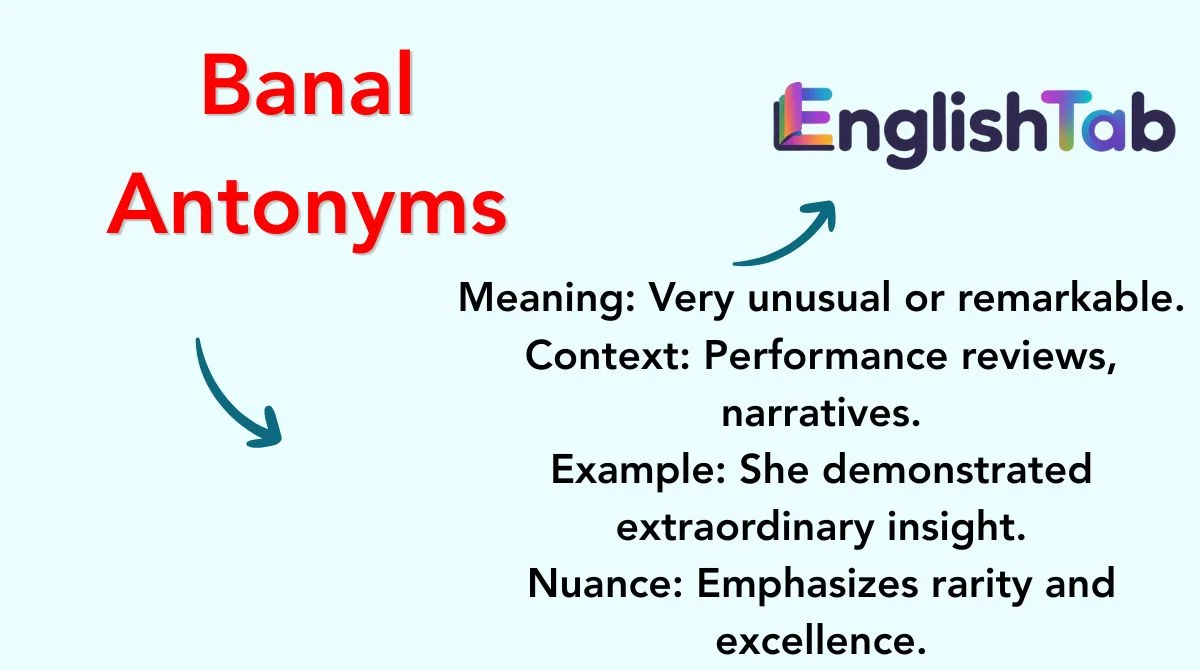
Extraordinary
Meaning: Very unusual or remarkable.
Context: Performance reviews, narratives.
Example: She demonstrated extraordinary insight.
Nuance: Emphasizes rarity and excellence.
Remarkable
Meaning: Worth attention or notice.
Context: Academic praise.
Example: The findings are remarkable for their depth.
Nuance: Highlights significance rather than innovation.
Exceptional
Meaning: Unusually good or outstanding.
Context: Evaluation reports.
Example: The paper shows exceptional clarity.
Nuance: Focuses on quality.
Groundbreaking
Meaning: Introducing radically new ideas.
Context: Research and science.
Example: The study is groundbreaking in its methodology.
Nuance: Implies historical importance.
Revolutionary
Meaning: Causing dramatic change.
Context: Political, technological analysis.
Example: The invention was revolutionary.
Nuance: Suggests transformation of systems.
Distinctive
Meaning: Clearly different from others.
Context: Style analysis.
Example: The author has a distinctive voice.
Nuance: Focuses on identity rather than innovation.
Fresh
Meaning: New and lively.
Context: Writing and design critique.
Example: The article offers a fresh perspective.
Nuance: Suggests energy more than originality.
Unconventional
Meaning: Not based on traditional norms.
Context: Social commentary.
Example: She proposed an unconventional solution.
Nuance: May imply risk or controversy.
Inspired
Meaning: Creatively stimulated or brilliant.
Context: Artistic evaluation.
Example: The performance was inspired.
Nuance: Suggests emotional depth.
Brilliant
Meaning: Exceptionally clever or impressive.
Context: Academic praise.
Example: It was a brilliant argument.
Nuance: Highlights intellectual strength.
Visionary
Meaning: Thinking about the future creatively.
Context: Leadership studies.
Example: The leader was visionary.
Nuance: Future-oriented innovation.
Trailblazing
Meaning: Pioneering new paths.
Context: Cultural or scientific progress.
Example: She is a trailblazing scientist.
Nuance: Emphasizes leadership in innovation.
Ingenious
Meaning: Clever and inventive.
Context: Engineering or problem-solving.
Example: The design is ingenious.
Nuance: Suggests intelligence and skill.
Profound
Meaning: Deep or intellectually significant.
Context: Philosophy, literature.
Example: The essay offers profound insight.
Nuance: Opposes banality through depth rather than novelty.
Antonym Comparison Table
| Word | Focus | Strength Level | Academic Suitability | Emotional Tone |
|---|---|---|---|---|
| Original | Newness | Moderate | High | Neutral |
| Innovative | Practical newness | Strong | Very High | Neutral |
| Creative | Imagination | Moderate | Medium | Positive |
| Groundbreaking | Historic impact | Very Strong | Very High | Formal |
| Revolutionary | System change | Extreme | High | Intense |
| Distinctive | Identity | Moderate | High | Neutral |
| Profound | Depth | Strong | Very High | Serious |
| Fresh | Energy | Mild | Medium | Light |
Academic Writing Examples
- Instead of writing:
The argument is banal. Write:
The argument lacks originality and fails to engage contemporary scholarship. - Instead of:
Her ideas are not banal. Write:
Her ideas are innovative and supported by empirical evidence. - Instead of:
The novel avoids banal themes. Write:
The novel explores unconventional themes through a distinctive narrative structure.
In academic contexts, precision matters. Choose the antonym that reflects whether you are praising creativity, depth, impact, or originality.
When Not to Replace the Word
Do not replace banal when:
- You are criticizing cliché language specifically.
- You are analyzing literary repetition intentionally.
- You need formal critical tone.
Sometimes banal is the most precise word. Overuse of strong antonyms like revolutionary may exaggerate meaning.
Practice Exercises
- Replace banal with a stronger antonym:
The presentation offered a __________ solution to climate policy. - Choose the best word:
The research was not banal; it was truly __________ in its methodology. - Rewrite:
The speech avoided banal expressions. - Identify nuance difference:
Compare innovative and visionary in two sentences.
FAQs
What is the strongest antonym for banal?
Groundbreaking or revolutionary are among the strongest, depending on context.
Is original always the best opposite?
Not necessarily. Original only suggests newness, while innovative implies practical advancement.
Can profound be an antonym?
Yes, when banality refers to shallow thinking.
Is unique stronger than original?
Yes. Unique implies singularity, not just independence from copying.
Should I use revolutionary in academic writing?
Only when evidence supports dramatic systemic change.
Conclusion
Understanding banal antonyms transforms the way we evaluate ideas, literature, and research.
Instead of simply labeling something as dull or predictable, writers can identify precise qualities that oppose banality—originality, depth, innovation, emotional power, or intellectual strength.
Strong writing depends on contrast. When you master these opposites, you sharpen your analytical voice, enrich your vocabulary, and elevate the clarity of your academic work.
Choose your antonyms carefully. Precision is the difference between ordinary writing and exceptional scholarship.

Dorian Hale is an English language enthusiast and content creator dedicated to making vocabulary and grammar learning simple, engaging, and accessible for everyone.