Clear writing depends on contrast. When writers understand opposites, they can sharpen arguments, define boundaries, and prevent ambiguity.
Antonyms do more than reverse meaning; they reveal scale, intensity, direction, and intention.
In academic and professional communication, choosing the precise opposite of a word like augment determines whether a sentence conveys reduction, limitation, destruction, or simple absence of growth.
The verb augment is common in scholarly, business, and technical contexts. Researchers augment data sets. Governments augment budgets.
Developers augment systems. But what happens when something moves in the opposite direction? Does it decrease slightly, collapse entirely, or merely remain unchanged?
This article explores 17+ augment antonyms, carefully categorized and contrasted. Each term is explained with nuance, context, and example so you can select the most accurate opposite in any professional setting.
Definition and Core Meaning of “Augment”
Augment means to increase, enhance, or make something greater in size, number, value, strength, or intensity. It implies intentional addition or expansion.
Key features of the word:
- Suggests deliberate action
- Implies measurable growth
- Often used in formal or academic contexts
- Can apply to quantity, quality, or capability
Example:
“The university augmented its research funding to expand scientific innovation.”
Because augment indicates purposeful growth, its antonyms may indicate reduction, limitation, removal, weakening, or even destruction.
Direct Opposites (Clear Contrasts)
These are the strongest and most literal antonyms of augment—they express clear reduction or reversal of increase.
- Decrease
- Reduce
- Diminish
- Curtail
- Lessen
- Cut
- Shrink
- Lower
- Minimize
- Deplete
- Subtract
- Withdraw
- Downgrade
- Contract
- Suppress
- Impair
- Weaken
Each of these words directly counters growth or expansion.
Contextual Opposites
Some words oppose augment only depending on context. They may indicate restriction, neutrality, or reversal without directly implying numerical decrease.
- Limit
- Restrict
- Cap
- Contain
- Stabilize
- Freeze
- Halt
- Reverse
- Offset
For example, “freeze funding” does not necessarily reduce funding, but it prevents augmentation.
Emotional & Tone-Based Opposites
Certain antonyms carry emotional or evaluative weight. They may imply damage, failure, or decline rather than simple reduction.
- Undermine
- Erode
- Cripple
- Devastate
- Deteriorate
- Depress
These words often suggest negative consequences beyond quantitative decrease.
17+ Antonyms Explained in Detail
Below are detailed explanations of key antonyms, including meaning, context, example, and nuance.
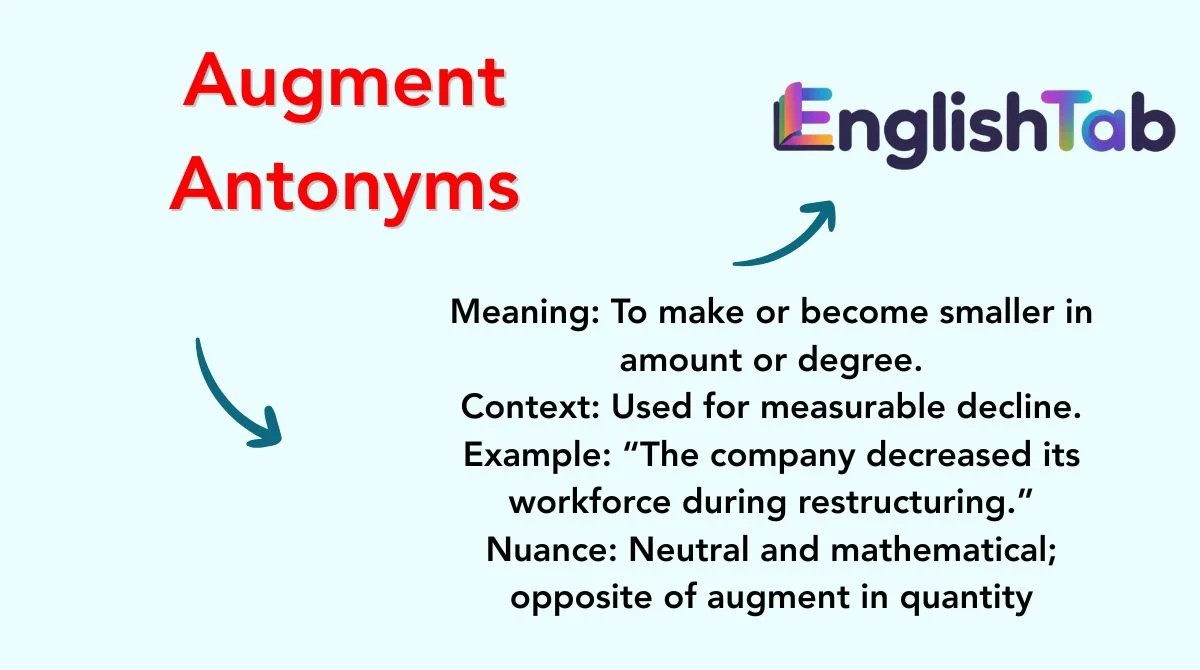
Decrease
Meaning: To make or become smaller in amount or degree.
Context: Used for measurable decline.
Example: “The company decreased its workforce during restructuring.”
Nuance: Neutral and mathematical; opposite of augment in quantity.
Reduce
Meaning: To make something smaller or less in size, number, or extent.
Context: Common in academic and policy writing.
Example: “The government reduced public spending.”
Nuance: Suggests deliberate control rather than natural decline.
Diminish
Meaning: To make or become less significant or intense.
Context: Often used for abstract qualities.
Example: “The error diminished the study’s credibility.”
Nuance: Implies gradual or subtle reduction.
Curtail
Meaning: To cut short or limit.
Context: Used in legal or policy discussions.
Example: “New laws curtailed corporate tax benefits.”
Nuance: Emphasizes restriction rather than natural decline.
Lessen
Meaning: To make smaller in degree or intensity.
Context: Emotional or experiential contexts.
Example: “The medication lessened the pain.”
Nuance: Softer than reduce; often partial.
Shrink
Meaning: To become smaller in size or number.
Context: Business or physical change.
Example: “The market shrank after the recession.”
Nuance: Often natural or involuntary change.
Lower
Meaning: To move to a less elevated level.
Context: Prices, expectations, standards.
Example: “The retailer lowered prices.”
Nuance: Focuses on downward movement.
Minimize
Meaning: To reduce to the smallest possible amount.
Context: Risk management and research writing.
Example: “The experiment minimized external variables.”
Nuance: Suggests optimization rather than simple reduction.
Deplete
Meaning: To use up or exhaust resources.
Context: Environmental or financial contexts.
Example: “Overfishing depleted marine populations.”
Nuance: Stronger than reduce; suggests near exhaustion.
Subtract
Meaning: To take away from a total.
Context: Mathematical or symbolic contexts.
Example: “The analyst subtracted expenses from revenue.”
Nuance: Precise numerical opposite.
Withdraw
Meaning: To remove something previously provided.
Context: Financial, political, institutional.
Example: “The sponsor withdrew funding.”
Nuance: Implies removal rather than gradual decrease.
Downgrade
Meaning: To lower in status or quality.
Context: Ratings, systems, performance levels.
Example: “The credit agency downgraded the company.”
Nuance: Focuses on quality rather than quantity.
Contract
Meaning: To shrink or reduce in size.
Context: Economic or biological contexts.
Example: “The economy contracted in the third quarter.”
Nuance: Formal and analytical term.
Suppress
Meaning: To forcibly prevent growth or expression.
Context: Political or biological discussions.
Example: “The policy suppressed innovation.”
Nuance: Implies active control or force.
Impair
Meaning: To weaken or damage function.
Context: Health or system performance.
Example: “Lack of sleep impaired cognitive ability.”
Nuance: Focuses on functionality.
Weaken
Meaning: To make less strong.
Context: Physical, emotional, structural contexts.
Example: “The storm weakened infrastructure.”
Nuance: Focuses on strength, not necessarily size.
Undermine
Meaning: To weaken gradually or secretly.
Context: Trust, authority, stability.
Example: “Corruption undermined public confidence.”
Nuance: Subtle and often hidden erosion.
Erode
Meaning: To wear away gradually.
Context: Physical or metaphorical decline.
Example: “Inflation eroded purchasing power.”
Nuance: Slow, continuous damage.
Antonym Comparison Table
| Word | Focus Area | Intensity | Implies Intent? | Common Context |
|---|---|---|---|---|
| Decrease | Quantity | Moderate | Neutral | Data, metrics |
| Reduce | Quantity | Moderate | Yes | Policy |
| Diminish | Quality/Impact | Mild | Neutral | Reputation |
| Curtail | Limitation | Strong | Yes | Law |
| Deplete | Resources | Strong | Often | Environment |
| Withdraw | Removal | Strong | Yes | Funding |
| Downgrade | Status | Moderate | Yes | Ratings |
| Undermine | Stability | Subtle | Often | Trust |
| Suppress | Growth | Strong | Yes | Innovation |
Academic Writing Examples
- “While the intervention aimed to augment productivity, budget cuts ultimately reduced operational capacity.”
- “The stimulus package augmented employment rates, whereas regulatory burdens curtailed entrepreneurial expansion.”
- “Although the policy sought to augment healthcare access, funding withdrawals diminished its long-term impact.”
These examples demonstrate contrast-driven clarity. The antonym selected must match the dimension being reversed.
When Not to Replace the Word
Do not replace augment when:
- The growth is qualitative rather than quantitative.
- The opposite is not actual reduction but stabilization.
- The sentence requires neutral description without implied decline.
- The context concerns enhancement rather than expansion.
For example, “The software augmented user experience” should not be reversed with “The software decreased user experience” if the intended meaning is “failed to improve.”
Practice Exercises
Choose the most precise antonym:
- The recession ________ consumer spending significantly.
- The board decided to ________ unnecessary expenses.
- Corruption can ________ democratic institutions.
- Excessive logging may ________ forest resources.
- The agency ________ its financial support last year.
Answers:
- Contracted
- Reduce
- Undermine
- Deplete
- Withdrew
FAQs
What is the strongest antonym of augment?
“Reduce” and “decrease” are the most direct opposites in general contexts, but “deplete” is stronger when referring to resources.
Is diminish the same as reduce?
Not exactly. “Diminish” often suggests gradual or less measurable decline, while “reduce” implies deliberate action.
Can suppress be an antonym of augment?
Yes, when referring to preventing growth, such as suppressing innovation or immune response.
Does stabilize mean the opposite of augment?
Only contextually. Stabilize prevents growth but does not necessarily reduce.
Which antonym works best in academic writing?
“Reduce,” “curtail,” “contract,” and “diminish” are widely accepted in formal academic contexts.
Conclusion
Understanding 17+ augment antonyms empowers writers to express precise contrasts.
Because augment signals deliberate growth, its opposites vary across dimensions—quantity, quality, intensity, function, and emotional weight.
Choosing the right antonym depends on:
- What is changing
- How strongly it changes
- Whether the action is intentional
- Whether the effect is measurable or abstract
Mastering these distinctions enhances clarity, authority, and analytical depth in academic and professional writing.

Dorian Hale is an English language enthusiast and content creator dedicated to making vocabulary and grammar learning simple, engaging, and accessible for everyone.