Language gains clarity through contrast. In academic writing, rhetoric, and everyday communication, understanding opposites sharpens meaning.
When a writer chooses a word, they also reject its alternatives. Knowing antonyms is not simply about vocabulary expansion—it is about intellectual precision.
The word apology carries emotional, ethical, and rhetorical weight. It signals regret, responsibility, humility, and reconciliation.
Its opposites, therefore, represent very different stances: defiance, denial, justification, accusation, pride, and hostility.
This article presents 19+ apology antonyms with deep comparison, contextual nuance, tone analysis, and academic usage guidance.
Rather than offering a simple list, we will explore how each opposing term functions in discourse and when it truly contrasts with “apology.”
Definition and Core Meaning of “Apology”
An apology is a statement expressing regret, acknowledgment of wrongdoing, and often a desire to repair harm. It contains three essential elements:
- Recognition of fault
- Expression of remorse
- Intention to reconcile or correct
In academic and rhetorical contexts, an apology may also appear as a formal defense (historically, from Greek apologia meaning “a speech in defense”). However, in modern usage, apology most commonly means admitting fault and expressing regret.
Because apology is rooted in humility and accountability, its antonyms typically represent rejection of responsibility or escalation of conflict.
Direct Opposites (Clear Contrasts)
These words most strongly contradict the core meaning of apology:
Denial
Refusal
Justification
Accusation
Blame
Defiance
Boasting
Pride
Attack
Condemnation
Criticism
Protest
Rejection
Insult
Arrogance
Retaliation
Mockery
Disapproval
Vindication
These terms oppose apology because they remove remorse and replace it with resistance, self-defense, or aggression.
Contextual Opposites
Some words function as opposites depending on the situation:
Defense
Excuse
Rationalization
Assertion
Challenge
Confrontation
Objection
For example, a defense can oppose an apology when someone argues they did nothing wrong. However, in legal or academic contexts, defense may be neutral rather than oppositional.
Thus, contextual antonyms depend heavily on speaker intention.
Emotional & Tone-Based Opposites
An apology expresses humility and regret. Tone-based opposites shift emotional energy in different directions:
Low Intensity Opposites
Disagreement
Correction
Clarification
Moderate Intensity Opposites
Objection
Defense
Assertion
High Intensity Opposites
Attack
Retaliation
Condemnation
Mockery
The greater the emotional escalation, the further the tone moves from apology toward confrontation.
19+ Antonyms Explained in Detail
Denial
Meaning: Refusal to admit truth or responsibility.
Context: Used when someone rejects fault.
Example: The company issued a denial instead of an apology.
Nuance: Denial directly contradicts acknowledgment, which is central to apology.
Refusal
Meaning: Declining to do something.
Context: Rejecting the act of apologizing.
Example: His refusal to apologize worsened the conflict.
Nuance: Refusal emphasizes action avoidance rather than emotional stance.
Justification
Meaning: Providing reasons to defend behavior.
Context: Explaining why an action was acceptable.
Example: Her speech sounded more like justification than remorse.
Nuance: Justification replaces regret with reasoning.
Accusation
Meaning: Claiming someone else is at fault.
Context: Shifting blame outward.
Example: Instead of apologizing, he made an accusation.
Nuance: Accusation reverses responsibility direction.
Blame
Meaning: Assigning fault.
Context: Redirecting responsibility.
Example: The meeting turned into blame rather than apology.
Nuance: Blame externalizes what apology internalizes.
Defiance
Meaning: Open resistance or bold disobedience.
Context: Refusing to express regret deliberately.
Example: Her defiance shocked the audience.
Nuance: Defiance adds emotional intensity absent in apology.
Boasting
Meaning: Proud self-praise.
Context: Celebrating actions instead of regretting them.
Example: His boasting replaced any chance of reconciliation.
Nuance: Boasting contradicts humility.
Pride
Meaning: Feeling of deep satisfaction in oneself.
Context: When pride prevents apology.
Example: His pride stopped him from admitting error.
Nuance: Pride is internal emotion; apology requires humility.
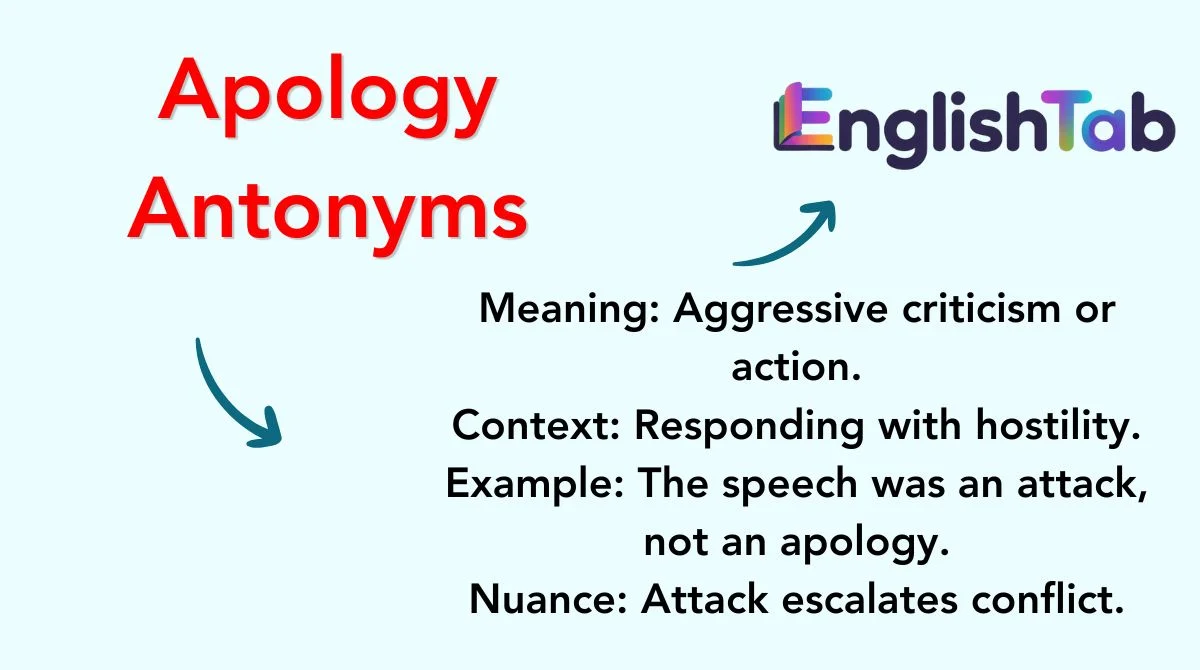
Attack
Meaning: Aggressive criticism or action.
Context: Responding with hostility.
Example: The speech was an attack, not an apology.
Nuance: Attack escalates conflict.
Condemnation
Meaning: Strong public disapproval.
Context: Declaring wrongdoing in others.
Example: The article issued condemnation instead of regret.
Nuance: Condemnation judges rather than repents.
Criticism
Meaning: Expressing disapproval.
Context: Highlighting faults in others.
Example: He offered criticism rather than apology.
Nuance: Less intense than attack but still oppositional.
Protest
Meaning: Expressing objection.
Context: Public disagreement.
Example: The group organized a protest instead of apologizing.
Nuance: Protest may be justified; apology implies wrongdoing.
Rejection
Meaning: Dismissal of an idea or request.
Context: Declining responsibility.
Example: Her rejection of fault was firm.
Nuance: Rejection is broader than refusal.
Insult
Meaning: Disrespectful remark.
Context: Aggravating harm instead of repairing it.
Example: The response was an insult.
Nuance: Insult deepens offense.
Arrogance
Meaning: Overbearing pride.
Context: Feeling superior instead of regretful.
Example: His arrogance blocked reconciliation.
Nuance: Arrogance is character-based; apology is action-based.
Retaliation
Meaning: Returning harm for harm.
Context: Escalating conflict.
Example: The company chose retaliation over apology.
Nuance: Retaliation intensifies hostility.
Mockery
Meaning: Ridicule.
Context: Making fun of the harmed party.
Example: His mockery offended everyone.
Nuance: Mockery denies seriousness.
Disapproval
Meaning: Mild expression of dislike.
Context: Expressing negative judgment.
Example: She expressed disapproval instead of remorse.
Nuance: Lower intensity than condemnation.
Vindication
Meaning: Clearing oneself of blame.
Context: Proving innocence.
Example: The evidence led to vindication.
Nuance: Vindication implies no wrongdoing, making apology unnecessary.
Defense
Meaning: Protecting oneself from accusation.
Context: Arguing innocence.
Example: He offered a defense rather than apology.
Nuance: Defense may be factual, not emotional.
Antonym Comparison Table
| Word | Accepts Fault? | Emotional Tone | Conflict Level | Typical Context |
|---|---|---|---|---|
| Denial | No | Neutral–Firm | Moderate | Public statements |
| Justification | No | Reasoned | Low–Moderate | Explanations |
| Defiance | No | Bold | High | Political speech |
| Attack | No | Aggressive | Very High | Debates |
| Condemnation | No | Harsh | High | Media/editorials |
| Pride | No | Internal | Low | Personal conflict |
| Retaliation | No | Angry | Very High | Escalated disputes |
| Vindication | No (claims innocence) | Assertive | Low–Moderate | Legal/academic |
This table shows that while all oppose apology, their intensity and rhetorical function vary significantly.
Academic Writing Examples
- The organization issued a denial rather than an apology, reinforcing public distrust.
- His justification failed to address the emotional damage caused.
- The minister’s defiance intensified political polarization.
- Instead of apology, the article presented condemnation.
- Her refusal to accept fault hindered conflict resolution.
In academic writing, selecting the correct antonym shapes interpretation. A “denial” suggests factual disagreement, while “retaliation” implies deliberate escalation.
When Not to Replace the Word
Do not replace “apology” with an antonym if:
- The situation involves legal defense rather than emotional regret.
- The speaker genuinely denies wrongdoing based on evidence.
- Cultural norms discourage public apology but imply indirect remorse.
- The term “apology” refers to a formal defense (historical meaning).
Accuracy depends on context. Not every non-apology equals aggression.
Practice Exercises
- Replace “apology” with the most accurate antonym:
The CEO’s statement sounded more like __________ than remorse. - Identify intensity level:
Which word shows stronger opposition—criticism or retaliation? - Rewrite:
Instead of apologizing, he blamed others.
Replace with a single antonym. - Compare tone differences between denial and defiance.
- Write a short paragraph contrasting apology and justification in academic tone.
FAQs
What is the strongest antonym of apology?
Retaliation and attack represent the strongest opposites because they escalate conflict rather than resolve it.
Is denial always the opposite of apology?
In most modern contexts, yes. Denial rejects responsibility, which apology accepts.
Can justification sometimes include apology?
Yes. A speaker may apologize while also explaining context. In that case, justification softens but does not erase apology.
Is defense always an antonym?
No. Defense may simply clarify facts without emotional opposition.
Why is understanding antonyms important in academic writing?
Because precise contrast strengthens argument clarity and rhetorical control.
Conclusion
Understanding apology antonyms is more than memorizing vocabulary. It involves recognizing emotional tone, rhetorical direction, and responsibility dynamics.
An apology lowers conflict and restores balance. Its opposites—denial, defiance, accusation, retaliation, and others—shift discourse toward resistance or escalation.
Each antonym carries a distinct emotional intensity and contextual function.
For academic writers, selecting the correct contrast enhances clarity, strengthens argumentation, and avoids semantic confusion.
Mastery of these 19+ apology antonyms allows for sharper analysis, more persuasive writing, and greater linguistic authority in 2K26 and beyond.

Dorian Hale is an English language enthusiast and content creator dedicated to making vocabulary and grammar learning simple, engaging, and accessible for everyone.