Opposites are not just vocabulary tools—they are clarity tools. In academic writing, creative storytelling, persuasive essays, and daily communication, antonyms sharpen meaning by defining what something is not.
When students understand contrast, they understand precision.
Antonyms worksheets play a crucial role in developing this skill. They train learners to recognize meaning boundaries, analyze context, and compare emotional tone.
More importantly, they strengthen writing clarity. When a student replaces a vague word with a clear opposite, the sentence becomes sharper, more intentional, and more powerful.
For example:
- “The test was easy.”
- “The test was difficult.”
The second sentence does more than change a word. It changes the entire emotional frame.
This guide explores antonyms worksheets in depth—definitions, core meanings, direct contrasts, contextual shifts, emotional differences, structured comparison, academic examples, and practice exercises.
By the end, you will understand not just how opposites work, but how to teach, practice, and analyze them effectively.
Definition and Core Meaning of “Antonyms Worksheets”
Antonyms worksheets are structured educational materials designed to help learners identify, analyze, and apply words with opposite meanings.
Breaking it down:
- Antonym: A word that expresses a meaning opposite to another word.
- Worksheet: A guided activity sheet used for structured learning and practice.
Together, antonyms worksheets help students:
- Recognize direct opposites
- Understand contextual contrasts
- Compare emotional tone
- Strengthen sentence structure
- Improve academic vocabulary
At a deeper level, antonyms worksheets are contrast-analysis tools. They teach students how language defines meaning through opposition. In linguistics, meaning often exists on a spectrum. Antonyms help learners understand where words fall on that spectrum.
For example:
- Hot ↔ Cold
- Success ↔ Failure
- Increase ↔ Decrease
These pairs define meaning through difference.
Direct Opposites (Clear Contrasts)
Direct opposites are words with clear, fixed contrasts. They work in most contexts without changing meaning.
Below are 19 of the strongest antonym pairs commonly used in worksheets:
- Big ↔ Small
- Happy ↔ Sad
- Hot ↔ Cold
- Fast ↔ Slow
- Early ↔ Late
- Light ↔ Dark
- Full ↔ Empty
- Open ↔ Closed
- Begin ↔ End
- True ↔ False
- Strong ↔ Weak
- Clean ↔ Dirty
- Rich ↔ Poor
- High ↔ Low
- Inside ↔ Outside
- Hard ↔ Soft
- Up ↔ Down
- Success ↔ Failure
- Increase ↔ Decrease
These opposites represent binary contrasts. In worksheets, they are often used for:
- Matching exercises
- Fill-in-the-blanks
- Multiple choice
- Sentence rewriting
Their strength lies in clarity. Students immediately understand the contrast without needing context.
Contextual Opposites
Not all antonyms are fixed. Some depend on situation and usage.
Consider the word “light.”
- Light (not heavy) → Opposite: Heavy
- Light (brightness) → Opposite: Dark
The opposite changes based on meaning.
Another example: “Sharp.”
- Sharp (knife) → Dull
- Sharp (person) → Slow or unintelligent
- Sharp (turn) → Gentle
Contextual opposites require higher-level thinking. Worksheets at intermediate and advanced levels often include:
- Multiple meaning words
- Sentence-based contrast
- Paragraph analysis
These exercises teach students that language is flexible. Opposites are not mechanical; they are contextual.
Emotional & Tone-Based Opposites
Some antonyms differ not only in meaning but in emotional intensity.
Compare:
- Happy ↔ Sad
- Joyful ↔ Miserable
Both pairs show opposition, but emotional strength varies.
Tone-based opposites affect writing mood:
- Confident ↔ Doubtful
- Brave ↔ Cowardly
- Calm ↔ Anxious
- Optimistic ↔ Pessimistic
In academic writing, choosing the correct emotional opposite matters. For instance:
“The researcher was doubtful” suggests caution.
“The researcher was pessimistic” suggests negativity.
Antonyms worksheets that focus on tone improve emotional awareness in writing.
19+ Antonyms Explained in Detail
Below are detailed analyses of key antonyms commonly included in antonyms worksheets.
Big
Meaning: Large in size.
Context: Used to describe physical objects or importance.
Example: The building is big.
Nuance Difference: Opposite “small” suggests size reduction, not importance loss.
Small
Meaning: Little in size.
Context: Physical objects, numbers, or scale.
Example: She lives in a small house.
Nuance Difference: “Tiny” is stronger than small.
Happy
Meaning: Feeling pleasure or joy.
Context: Emotional state.
Example: The child felt happy after the game.
Nuance Difference: Opposite “sad” indicates emotional contrast, not anger.
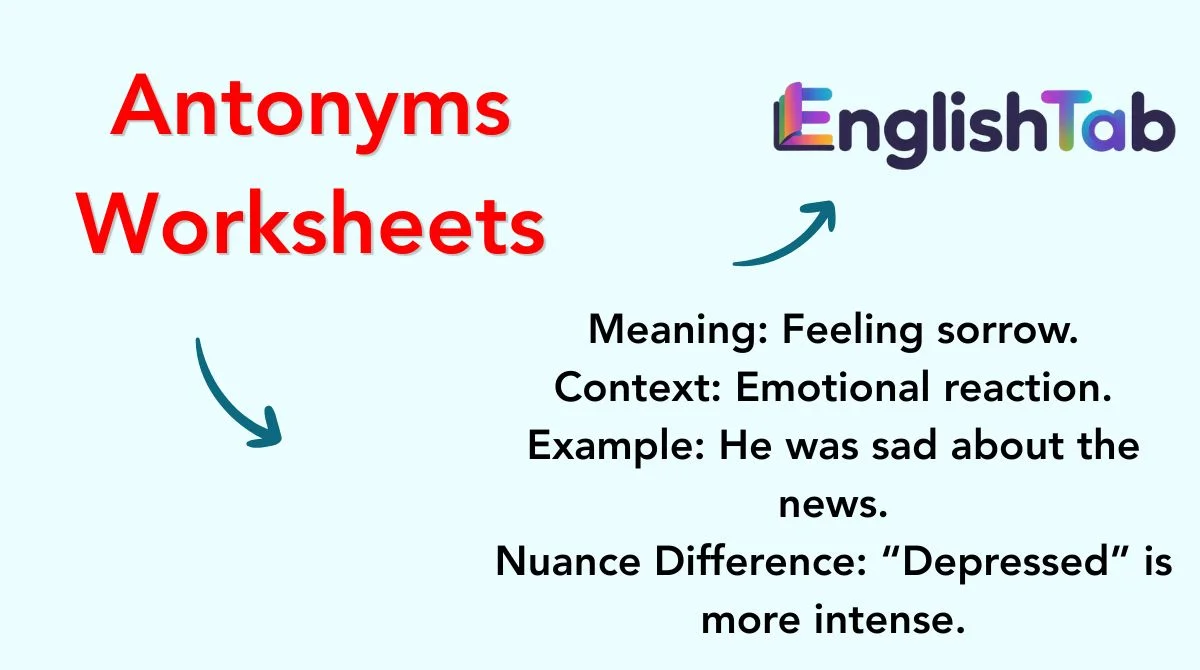
Sad
Meaning: Feeling sorrow.
Context: Emotional reaction.
Example: He was sad about the news.
Nuance Difference: “Depressed” is more intense.
Hot
Meaning: High temperature.
Context: Weather, objects, food.
Example: The tea is hot.
Nuance Difference: Opposite “cold” refers to temperature, not emotion.
Cold
Meaning: Low temperature.
Context: Weather or physical touch.
Example: The water is cold.
Nuance Difference: Can also imply emotional distance.
Strong
Meaning: Having physical power.
Context: People, materials, arguments.
Example: She gave a strong speech.
Nuance Difference: Opposite “weak” may imply lack of force or quality.
Weak
Meaning: Lacking strength.
Context: Physical or abstract.
Example: The argument was weak.
Nuance Difference: Not always negative—can indicate vulnerability.
Early
Meaning: Before expected time.
Context: Events, schedules.
Example: She arrived early.
Nuance Difference: Opposite “late” concerns timing only.
Late
Meaning: After expected time.
Context: Time reference.
Example: He was late for class.
Nuance Difference: Can also mean deceased in formal usage.
Full
Meaning: Containing maximum amount.
Context: Containers or schedules.
Example: The glass is full.
Nuance Difference: Opposite “empty” indicates absence.
Empty
Meaning: Containing nothing.
Context: Physical or emotional.
Example: The room was empty.
Nuance Difference: Can imply loneliness metaphorically.
Success
Meaning: Achievement of goals.
Context: Academic or professional.
Example: Hard work leads to success.
Nuance Difference: Opposite “failure” implies unmet goals.
Failure
Meaning: Lack of success.
Context: Outcomes.
Example: The project was a failure.
Nuance Difference: Can suggest learning opportunity.
Increase
Meaning: To become larger.
Context: Numbers, growth.
Example: Prices increase yearly.
Nuance Difference: Opposite “decrease” refers to reduction.
Decrease
Meaning: To become smaller.
Context: Quantitative change.
Example: The temperature will decrease.
Nuance Difference: Not necessarily negative.
Light
Meaning: Bright or not heavy.
Context: Multiple meanings.
Example: The bag is light.
Nuance Difference: Opposite depends on usage.
Dark
Meaning: Lacking light.
Context: Visual description.
Example: The room is dark.
Nuance Difference: Can imply mystery.
Rich
Meaning: Having wealth.
Context: Financial or descriptive.
Example: The family is rich.
Nuance Difference: Opposite “poor” may imply economic hardship.
Poor
Meaning: Lacking wealth.
Context: Financial condition.
Example: He grew up poor.
Nuance Difference: Also used for weak quality.
Antonym Comparison Table
| Word | Direct Opposite | Emotional Intensity | Context Sensitivity | Academic Usage |
|---|---|---|---|---|
| Happy | Sad | Moderate | Low | Common |
| Strong | Weak | Low–Moderate | Medium | High |
| Success | Failure | High | Low | Very High |
| Increase | Decrease | Neutral | Low | Very High |
| Rich | Poor | High | Medium | High |
| Light | Dark | Neutral | High | Medium |
| Early | Late | Neutral | Low | High |
| Full | Empty | Neutral | Medium | Medium |
This comparison highlights that not all opposites function equally. Some are emotionally charged. Others are neutral and technical.
Academic Writing Examples
- The results indicate a significant increase rather than a decrease in performance.
- The hypothesis proved true, not false.
- The structure is strong, not weak.
- The data suggest success instead of failure.
- The sample group showed high engagement compared to low participation.
These examples demonstrate clarity through contrast. Academic writing benefits from precise opposites because they eliminate ambiguity.
When Not to Replace the Word
Antonyms should not be used blindly.
Avoid replacing when:
- The word has multiple meanings.
- Emotional tone would shift too strongly.
- The context requires nuance rather than binary contrast.
- The opposite creates exaggeration.
For example:
“The argument was weak.”
Replacing with “The argument was strong” may misrepresent moderate strength.
Writers must evaluate meaning depth before substitution.
Practice Exercises
Exercise 1: Match the Opposites
- Early
- Rich
- Strong
- Increase
- Full
Options: Poor, Late, Decrease, Weak, Empty
Exercise 2: Fill in the Blank
- The room was ______, not empty.
- The athlete was strong, not ______.
- Prices will increase, not ______.
Exercise 3: Sentence Rewriting
Rewrite using the opposite word:
- The test was easy.
- The glass is full.
- She arrived early.
Exercise 4: Context Analysis
Choose the correct opposite of “light”:
- The bag is light.
- The room is light.
Explain your reasoning.
FAQs
What are antonyms worksheets used for?
They are used to teach word opposites, improve vocabulary, and strengthen writing clarity through contrast.
Why are opposites important in academic writing?
Opposites create precision. They allow writers to define meaning clearly by highlighting contrast.
Are all antonyms direct opposites?
No. Some depend on context and emotional tone.
How can students practice antonyms effectively?
Through matching activities, sentence rewriting, contextual analysis, and comparison tables.
Do antonyms always create balance?
Not always. Some opposites create intensity differences rather than equal contrast.
Conclusion
Antonyms worksheets are more than vocabulary drills. They are analytical tools that teach contrast, precision, and clarity.
Through direct opposites, contextual contrasts, and emotional comparisons, students develop stronger writing skills.
Understanding 19+ core antonyms builds a foundation. Analyzing nuance builds mastery. Practicing structured exercises builds confidence.
In 2K26 and beyond, effective writing depends on clarity. And clarity depends on understanding opposites.

Dorian Hale is an English language enthusiast and content creator dedicated to making vocabulary and grammar learning simple, engaging, and accessible for everyone.