Opposites sharpen meaning. In academic, creative, and professional writing, clarity often depends on contrast. When we understand what a word is not, we better understand what it is.
This is especially true for emotionally charged words such as fear.
Fear is not merely a feeling—it is a psychological, biological, and rhetorical force. Writers rely on it to build tension, psychologists study it to understand behavior, and leaders manage it to guide decisions.
But effective writing requires range. Repeating the same word weakens impact. Replacing “fear” with the right antonym can shift tone from anxiety to confidence, from panic to strength, from danger to control.
This comprehensive guide explores 24+ antonyms of fear, examining their meanings, contexts, emotional intensity, and nuanced differences.
Whether you are an academic writer, student, educator, or content creator, this structured analysis will refine your vocabulary and improve clarity.
Definition and Core Meaning of “Fear”
Fear is a powerful emotional response to perceived danger, threat, or uncertainty. It activates survival mechanisms—fight, flight, or freeze.
Core characteristics of fear:
- Emotional distress
- Anticipation of harm
- Lack of control
- Vulnerability
- Avoidance response
Fear may be:
- Immediate (fear of a loud noise)
- Anticipatory (fear of failure)
- Social (fear of judgment)
- Existential (fear of death)
To understand its opposites, we must identify what fear removes:
- Calm
- Confidence
- Safety
- Courage
- Trust
- Stability
Its antonyms restore one or more of these elements.
Direct Opposites (Clear Contrasts)
The following 24 words represent the strongest and most direct antonyms of fear:
- Courage
- Bravery
- Boldness
- Confidence
- Calm
- Peace
- Serenity
- Assurance
- Trust
- Faith
- Security
- Safety
- Comfort
- Relief
- Optimism
- Hope
- Determination
- Strength
- Stability
- Composure
- Fearlessness
- Valor
- Grit
- Daring
Each of these directly contrasts fear by replacing threat with strength, anxiety with control, or danger with safety.
Contextual Opposites
Not all antonyms are permanent opposites. Some words oppose fear only in specific contexts.
- Curiosity (opposes fear of the unknown)
- Excitement (opposes fear when energy shifts to anticipation)
- Acceptance (oposes fear of change)
- Preparedness (opposes fear of uncertainty)
- Control (opposes fear rooted in helplessness)
- Resilience (opposes fear in adversity)
- Empowerment (opposes fear of limitation)
For example:
Fear of public speaking becomes curiosity about audience reaction.
Fear of failure becomes determination to improve.
Context determines the strength of opposition.
Emotional & Tone-Based Opposites
Antonyms differ in emotional intensity. Some are soft and internal; others are powerful and dramatic.
Low-intensity opposites:
- Calm
- Peace
- Composure
- Comfort
Medium-intensity opposites:
- Confidence
- Assurance
- Security
- Stability
High-intensity opposites:
- Bravery
- Valor
- Fearlessness
- Daring
Choosing the correct intensity is critical in academic writing. Overstating emotional contrast can weaken credibility.
24+ Antonyms Explained in Detail
Courage
Meaning: The ability to act despite fear.
Context: Used when someone confronts difficulty.
Example: She showed courage during the crisis.
Nuance: Courage does not eliminate fear; it overcomes it.
Bravery
Meaning: Bold action in dangerous situations.
Context: Often physical or heroic acts.
Example: The firefighter’s bravery saved lives.
Nuance: Bravery is more dramatic than courage.
Boldness
Meaning: Willingness to take risks.
Context: Innovation, leadership, creativity.
Example: His boldness changed the industry.
Nuance: Boldness can be strategic, not just emotional.
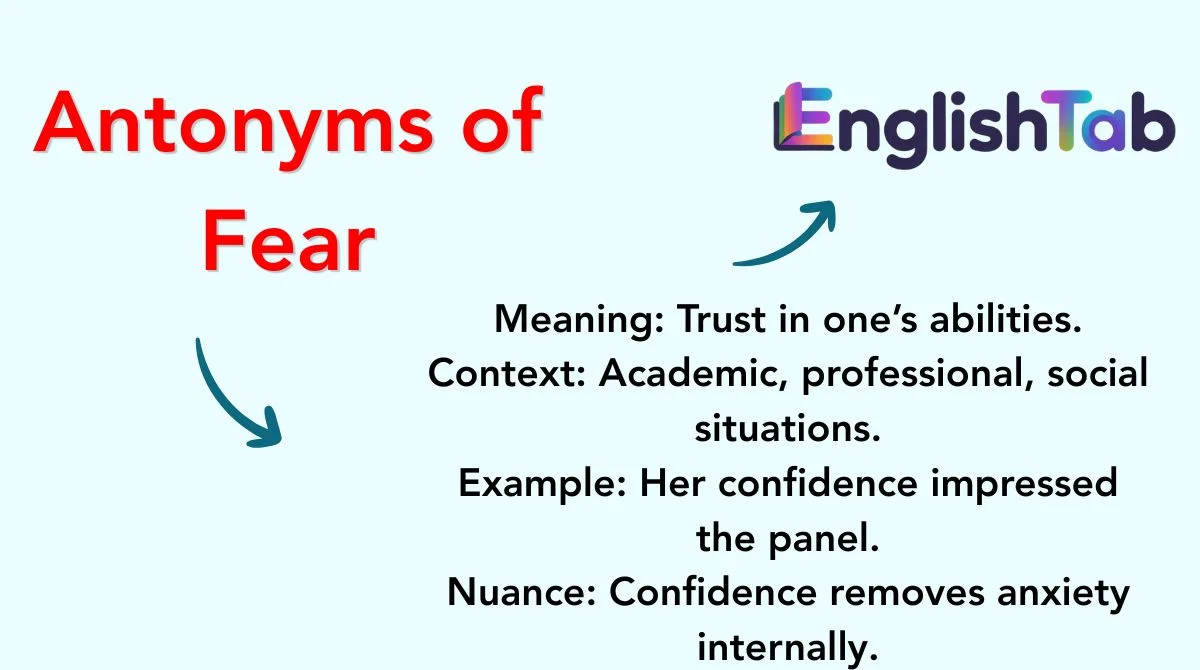
Confidence
Meaning: Trust in one’s abilities.
Context: Academic, professional, social situations.
Example: Her confidence impressed the panel.
Nuance: Confidence removes anxiety internally.
Calm
Meaning: Absence of agitation.
Context: Stressful situations.
Example: He remained calm during the emergency.
Nuance: Calm reduces emotional intensity rather than confronting fear.
Peace
Meaning: Mental or external tranquility.
Context: Emotional stability.
Example: Meditation brought her peace.
Nuance: Broader and deeper than calm.
Serenity
Meaning: Deep inner quiet.
Context: Reflective or spiritual tone.
Example: The lake reflected serenity.
Nuance: Poetic and softer than peace.
Assurance
Meaning: Freedom from doubt.
Context: Formal or academic tone.
Example: She spoke with assurance.
Nuance: Suggests stable confidence.
Trust
Meaning: Belief in reliability.
Context: Relationships and institutions.
Example: Trust replaces suspicion.
Nuance: Social opposite of fear.
Faith
Meaning: Strong belief without proof.
Context: Spiritual or emotional.
Example: Faith overcame fear.
Nuance: More abstract than trust.
Security
Meaning: Protection from danger.
Context: Political, social, financial.
Example: Security reduces public fear.
Nuance: Structural opposite.
Safety
Meaning: Freedom from harm.
Context: Physical protection.
Example: The shelter provided safety.
Nuance: Practical and direct contrast.
Comfort
Meaning: Physical or emotional ease.
Context: Personal situations.
Example: Comfort replaced anxiety.
Nuance: Soft emotional relief.
Relief
Meaning: Removal of stress or danger.
Context: After tension.
Example: He felt relief after the exam.
Nuance: Temporary opposite.
Optimism
Meaning: Expectation of positive outcomes.
Context: Future-oriented.
Example: Optimism defeated doubt.
Nuance: Cognitive opposite.
Hope
Meaning: Desire for positive possibility.
Context: Uncertain situations.
Example: Hope replaces despair.
Nuance: Emotional but not always confident.
Determination
Meaning: Firm resolve.
Context: Goals and ambition.
Example: Determination overcame fear.
Nuance: Active and forward-moving.
Strength
Meaning: Physical or mental power.
Context: Resilience.
Example: Inner strength conquered fear.
Nuance: Broader than bravery.
Stability
Meaning: Consistency and balance.
Context: Social systems or emotions.
Example: Stability calmed public fear.
Nuance: Systemic opposite.
Composure
Meaning: Controlled emotions.
Context: Professional tone.
Example: She answered with composure.
Nuance: Formal alternative to calm.
Fearlessness
Meaning: Complete absence of fear.
Context: Extreme bravery.
Example: Fearlessness defined the leader.
Nuance: Stronger than courage.
Valor
Meaning: Heroic courage.
Context: Military or epic tone.
Example: Soldiers fought with valor.
Nuance: Elevated and historical.
Grit
Meaning: Perseverance under pressure.
Context: Long-term struggle.
Example: Grit defeated fear of failure.
Nuance: Emphasizes endurance.
Daring
Meaning: Adventurous boldness.
Context: Risk-taking scenarios.
Example: Daring explorers crossed the desert.
Nuance: Can imply recklessness.
Antonym Comparison Table
| Word | Intensity | Emotional Tone | Context Type | Formality |
|---|---|---|---|---|
| Calm | Low | Neutral | Emotional | Neutral |
| Confidence | Medium | Positive | Academic | High |
| Courage | High | Strong | Narrative | Neutral |
| Bravery | High | Heroic | Physical | Neutral |
| Assurance | Medium | Stable | Professional | High |
| Serenity | Low | Soft | Reflective | Literary |
| Valor | High | Epic | Historical | Formal |
| Security | Medium | Protective | Institutional | Formal |
| Hope | Medium | Emotional | Personal | Neutral |
Academic Writing Examples
- Instead of: “The population lived in fear.”
Use: “The population lacked a sense of security.” - Instead of: “Fear influenced decisions.”
Use: “A deficit of confidence influenced decision-making.” - Instead of: “Fear spread rapidly.”
Use: “Public anxiety replaced institutional trust.” - Instead of: “He acted without fear.”
Use: “He acted with notable composure.”
Precision increases authority.
When Not to Replace the Word
Avoid replacing “fear” when:
- Discussing clinical psychology (fear response has specific meaning)
- Quoting data or research terminology
- Referring to biological reactions
- Describing phobias
Example:
“Fear activates the amygdala.”
Replacing fear here would reduce scientific accuracy.
Practice Exercises
- Replace “fear” with the most appropriate antonym:
a) Her _______ allowed her to speak confidently.
b) National _______ reduced public anxiety.
c) His _______ in the face of danger inspired others. - Compare “confidence” and “assurance” in two sentences.
- Write a paragraph replacing fear in an academic context.
FAQs
What is the strongest antonym of fear?
Fearlessness is the most absolute opposite because it implies zero fear.
Is courage the same as fearlessness?
No. Courage involves acting despite fear. Fearlessness implies absence of fear.
Which antonym is best for academic writing?
Confidence, assurance, stability, and security are most appropriate.
Can hope be an antonym of fear?
Yes, when fear relates to uncertainty about the future.
Are calm and peace interchangeable?
Not always. Calm refers to reduced agitation; peace suggests deeper harmony.
Conclusion
Mastering antonyms of fear enhances clarity, tone control, and academic precision. From calm to valor, each opposite provides a different emotional intensity and contextual application.
Strong writing depends on accurate contrast. When fear signals vulnerability, its antonyms signal strength, control, safety, or resolve.
Choosing the right one transforms ordinary language into authoritative expression.
Understanding these distinctions does more than improve vocabulary—it strengthens thought, structure, and scholarly communication.

Dorian Hale is an English language enthusiast and content creator dedicated to making vocabulary and grammar learning simple, engaging, and accessible for everyone.