Strong writing depends on contrast. When we understand opposites, we understand meaning more clearly. Antonyms sharpen arguments, refine tone, and prevent vague expression.
In academic and professional writing, choosing the correct opposite of a word like “legacy” is not simple. The concept carries historical, emotional, cultural, and legal weight.
The word “legacy” suggests inheritance, continuity, influence, reputation, and long-term impact. Its opposites, therefore, are not limited to one simple word.
They vary depending on context — whether legal, historical, emotional, or institutional.
This article provides 22+ antonyms for legacy, explained in depth, compared carefully, and organized for academic clarity.
Definition and Core Meaning of “Legacy”
“Legacy” refers to something handed down from the past. It can be:
- Material (property, money)
- Cultural (traditions, values)
- Intellectual (ideas, research)
- Institutional (policies, systems)
- Personal (reputation, influence)
In academic terms, legacy represents continuity across time. It implies endurance, transmission, and long-term effect.
Therefore, its antonyms often imply:
- Absence of inheritance
- Loss or destruction
- Discontinuity
- Erasure
- Rejection of the past
- Ephemeral existence
Understanding this conceptual core helps identify the strongest opposites.
Direct Opposites (Clear Contrasts)
These words most strongly contradict the central idea of legacy:
- Oblivion
- Erasure
- Extinction
- Dissolution
- Demolition
- Destruction
- Ruin
- Disappearance
- Annihilation
- Abandonment
- Neglect
- Rejection
- Severance
- Interruption
- Disinheritance
- Forfeiture
- Loss
- Waste
- Decay
- Collapse
- Nullification
- Termination
These antonyms oppose continuity and inheritance directly.
Contextual Opposites
Some words act as antonyms only in certain contexts.
- Innovation (opposes tradition-based legacy)
- Modernity (contrasts inherited systems)
- Reform (rejects historical continuation)
- Breakthrough (disrupts inherited models)
- Improvisation (opposes structured inheritance)
- Presentism (focus on present over historical continuity)
In reformist discourse, legacy often implies rigidity. In that setting, innovation becomes its functional opposite.
Emotional & Tone-Based Opposites
Legacy often carries positive emotional weight. Emotional opposites shift tone dramatically.
- Infamy (negative remembrance)
- Shame (damaging personal inheritance)
- Stigma (burdened reputation)
- Disgrace (public dishonor)
- Blight (harmful lasting effect)
- Curse (damaging inherited condition)
These words contrast legacy by reversing its emotional charge.
22+ Antonyms Explained in Detail
Below are detailed explanations of 24 key antonyms.
Oblivion
Meaning: Complete forgetting or being forgotten.
Context: Used when a person’s work leaves no lasting memory.
Example: The failed regime faded into oblivion.
Nuance: Unlike destruction, oblivion focuses on memory loss rather than physical elimination.
Erasure
Meaning: Removal from record or existence.
Context: Cultural or historical deletion.
Example: The policy led to the erasure of indigenous languages.
Nuance: Erasure implies deliberate removal, while legacy implies preservation.
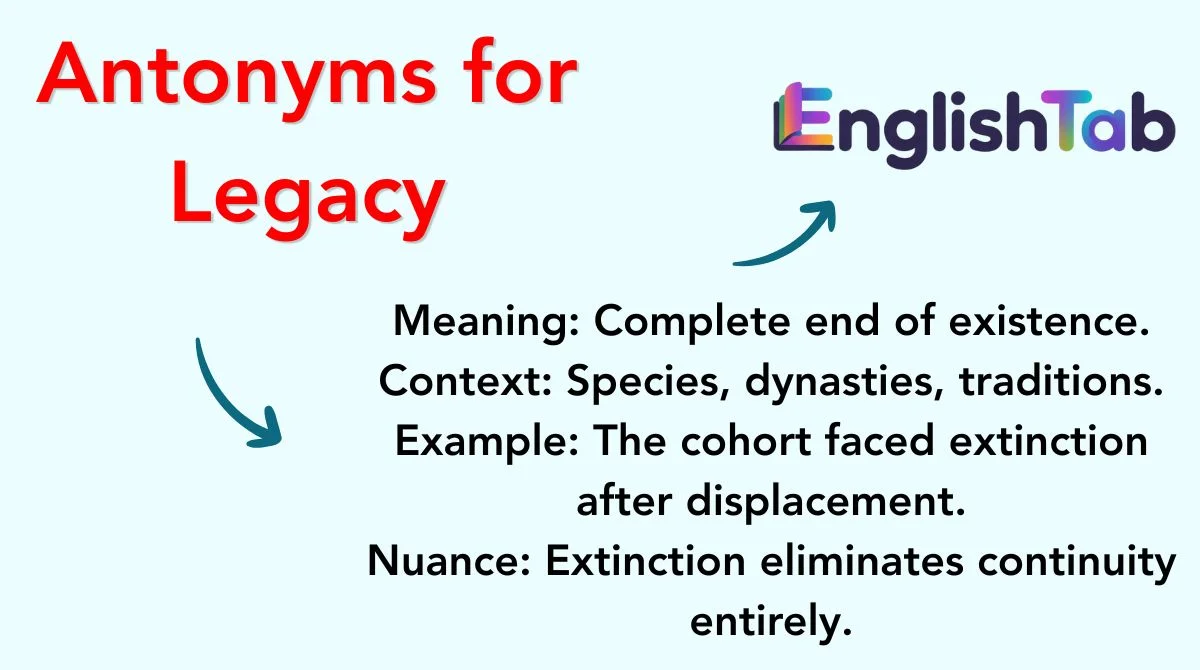
Extinction
Meaning: Complete end of existence.
Context: Species, dynasties, traditions.
Example: The cohort faced extinction after displacement.
Nuance: Extinction eliminates continuity entirely.
Dissolution
Meaning: Breaking apart or ending formally.
Context: Institutions or marriages.
Example: The dissolution of the empire erased its legacy.
Nuance: More structural than emotional.
Demolition
Meaning: Physical destruction.
Context: Buildings, monuments.
Example: The demolition of the historic hall ended its architectural legacy.
Nuance: Concrete and physical.
Destruction
Meaning: Total ruin.
Context: War, disaster.
Example: The archives suffered destruction in the fire.
Nuance: Broader than demolition.
Ruin
Meaning: Severe damage.
Context: Moral or structural collapse.
Example: Corruption led to the ruin of his reputation.
Nuance: Suggests gradual decay.
Disappearance
Meaning: Ceasing to be visible or present.
Context: Cultural practices fading.
Example: The custom faces disappearance.
Nuance: Often gradual and passive.
Annihilation
Meaning: Complete destruction.
Context: Warfare or ideology.
Example: The invasion caused annihilation of the dynasty.
Nuance: Stronger and more violent than destruction.
Abandonment
Meaning: Leaving behind.
Context: Neglected traditions.
Example: Urban migration led to abandonment of rural heritage.
Nuance: Suggests choice rather than force.
Neglect
Meaning: Failure to care for.
Context: Cultural institutions.
Example: Years of neglect weakened the archive.
Nuance: Passive contrast to intentional preservation.
Rejection
Meaning: Refusal to accept.
Context: Ideological breaks.
Example: The new leader signaled rejection of colonial legacy.
Nuance: Active ideological contrast.
Severance
Meaning: Cutting off connection.
Context: Legal or institutional contexts.
Example: Severance from tradition allowed modernization.
Nuance: Formal and structural.
Interruption
Meaning: Temporary break.
Context: Policy or reform cycles.
Example: War caused interruption in cultural transmission.
Nuance: Unlike extinction, interruption may resume.
Disinheritance
Meaning: Exclusion from inheritance.
Context: Legal matters.
Example: His disinheritance ended the family line’s legacy.
Nuance: Specific to property or status.
Forfeiture
Meaning: Loss due to wrongdoing.
Context: Legal penalties.
Example: Forfeiture of titles erased dynastic influence.
Nuance: Implies punishment.
Loss
Meaning: Absence of something valuable.
Context: Memory, tradition.
Example: The loss of elders reduced oral legacy.
Nuance: Emotionally softer than destruction.
Waste
Meaning: Failure to use or preserve.
Context: Talent or opportunity.
Example: The project became a waste of inherited knowledge.
Nuance: Suggests misuse.
Decay
Meaning: Gradual deterioration.
Context: Buildings or moral systems.
Example: Cultural decay weakened national identity.
Nuance: Slow decline versus abrupt end.
Collapse
Meaning: Sudden failure.
Context: Political systems.
Example: The economic collapse ended decades of prosperity.
Nuance: Implies internal weakness.
Nullification
Meaning: Making legally void.
Context: Contracts, laws.
Example: Court nullification ended the program’s legacy.
Nuance: Legal focus.
Termination
Meaning: Formal ending.
Context: Employment, agreements.
Example: Termination of funding halted the initiative.
Nuance: Administrative tone.
Infamy
Meaning: Negative reputation.
Context: Public memory.
Example: The dictator’s legacy became infamy.
Nuance: Opposes positive remembrance.
Stigma
Meaning: Social disgrace.
Context: Social history.
Example: The scandal left lasting stigma.
Nuance: Focus on public perception.
Antonym Comparison Table
| Word | Strength Level | Emotional Tone | Permanent? | Legal Context? |
|---|---|---|---|---|
| Oblivion | High | Neutral | Yes | No |
| Erasure | High | Neutral | Yes | Sometimes |
| Extinction | Extreme | Neutral | Yes | No |
| Abandonment | Medium | Mild | No | No |
| Rejection | Medium | Active | No | No |
| Disinheritance | High | Neutral | Yes | Yes |
| Collapse | High | Negative | Often | No |
| Nullification | Medium | Neutral | Yes | Yes |
| Infamy | Emotional | Negative | Yes | No |
Academic Writing Examples
- The administration’s reform signaled rejection of its predecessor’s legacy.
- The extinction of the dialect represents cultural loss.
- Legal nullification dissolved the institutional continuity.
- Public infamy replaced what was once admired leadership.
- Structural collapse prevented long-term influence.
These examples demonstrate tone variation and contextual precision.
When Not to Replace the Word
Do not replace “legacy” when:
- The context requires neutral inheritance.
- Emotional weight is central.
- Historical continuity is the focus.
- Legal inheritance is explicitly referenced.
Using “destruction” instead of “loss” may exaggerate meaning. Choosing “innovation” instead of “rejection” may distort tone.
Precision is critical.
Practice Exercises
- Replace “legacy” with a stronger antonym in a sentence about cultural disappearance.
- Identify whether “collapse” or “decay” better contrasts with legacy in a political essay.
- Write two sentences contrasting “legacy” with “innovation.”
- Revise a paragraph using “oblivion” instead of “loss.”
FAQs
What is the strongest antonym for legacy?
“Extinction” and “annihilation” are the strongest because they remove continuity entirely.
Is innovation always an antonym of legacy?
No. Innovation can build on legacy rather than oppose it.
What is the legal opposite of legacy?
“Disinheritance” and “forfeiture” function as legal opposites.
Can legacy have negative meaning?
Yes. In political writing, legacy may refer to harmful inherited systems.
Conclusion
Understanding antonyms for legacy requires conceptual precision. The word implies inheritance, endurance, and long-term influence.
Its opposites therefore center on erasure, discontinuity, destruction, rejection, or negative remembrance.
Writers must choose carefully between structural, emotional, and legal contrasts. Mastery of these distinctions improves clarity, argument strength, and analytical depth.
In academic writing, contrast is not about vocabulary variety alone — it is about conceptual accuracy.

Dorian Hale is an English language enthusiast and content creator dedicated to making vocabulary and grammar learning simple, engaging, and accessible for everyone.