Clear writing depends on contrast. When writers understand not only what a word means but also what stands in opposition to it, they gain precision and control.
Opposites help sharpen arguments, clarify reasoning, and prevent misunderstanding. In academic contexts especially, choosing the correct contrast word can determine whether a statement sounds analytical, emotional, speculative, or factual.
The verb infer plays a central role in reasoning. It signals that a conclusion is drawn from evidence rather than directly stated.
However, there are many situations where writers need the opposite of inference — where something is explicit, declared, proven, clarified, or confirmed instead of deduced.
This guide explores 22+ antonyms for infer, organized by clarity, context, and tone. Each word is examined in depth so that you can choose the strongest contrast in academic and professional writing.
Definition and Core Meaning of “Infer”
To infer means to reach a conclusion based on evidence, reasoning, or hints rather than direct statements. It involves interpretation.
When you infer, you:
- Draw a logical conclusion
- Interpret indirect information
- Read between the lines
- Deduce from clues
Example:
From the dark clouds, we infer that it will rain.
The rain is not happening yet, but the conclusion is formed from observation.
Because infer is rooted in reasoning from indirect evidence, its opposites generally fall into three broad categories:
- Words that indicate direct statement
- Words that indicate proof or certainty
- Words that indicate clarification instead of assumption
Direct Opposites (Clear Contrasts)
These antonyms represent the strongest and clearest contrasts to infer. They remove interpretation and replace it with directness or explicit communication.
Here are 22 of the strongest antonyms for infer:
State
Declare
Explain
Clarify
Specify
Assert
Announce
Proclaim
Reveal
Disclose
Confirm
Prove
Demonstrate
Show
Establish
Verify
Affirm
Express
Articulate
Spell out
Detail
Indicate (when used directly, not suggestively)
Each of these words shifts meaning away from assumption and toward certainty or openness.
Contextual Opposites
Some words oppose infer depending on how they are used. They may not always be strict antonyms, but in specific contexts they function as meaningful contrasts.
Examples include:
Deny
Refute
Contradict
Correct
Negate
Disprove
Retract
Clarify
Elaborate
Define
For instance, if someone infers incorrectly, a speaker may refute or correct that inference. In these situations, the opposition is not just logical but argumentative.
Emotional & Tone-Based Opposites
The tone of a word matters. Infer is neutral and analytical. Some opposites introduce stronger emotional force.
Compare:
Infer (calm reasoning)
Proclaim (public intensity)
Deny (defensive tone)
Affirm (positive conviction)
Refute (argumentative precision)
Clarify (calming explanation)
The emotional weight of the antonym can dramatically change the tone of a sentence. Academic writing typically prefers neutral contrasts such as clarify, demonstrate, confirm, or establish.
22+ Antonyms Explained in Detail
Below are detailed explanations of 22 powerful antonyms for infer.
State
Meaning: To say something clearly and directly.
Context: Used when information is plainly communicated.
Example: The report states that sales increased.
Nuance: Unlike infer, state removes interpretation; the information is explicit.
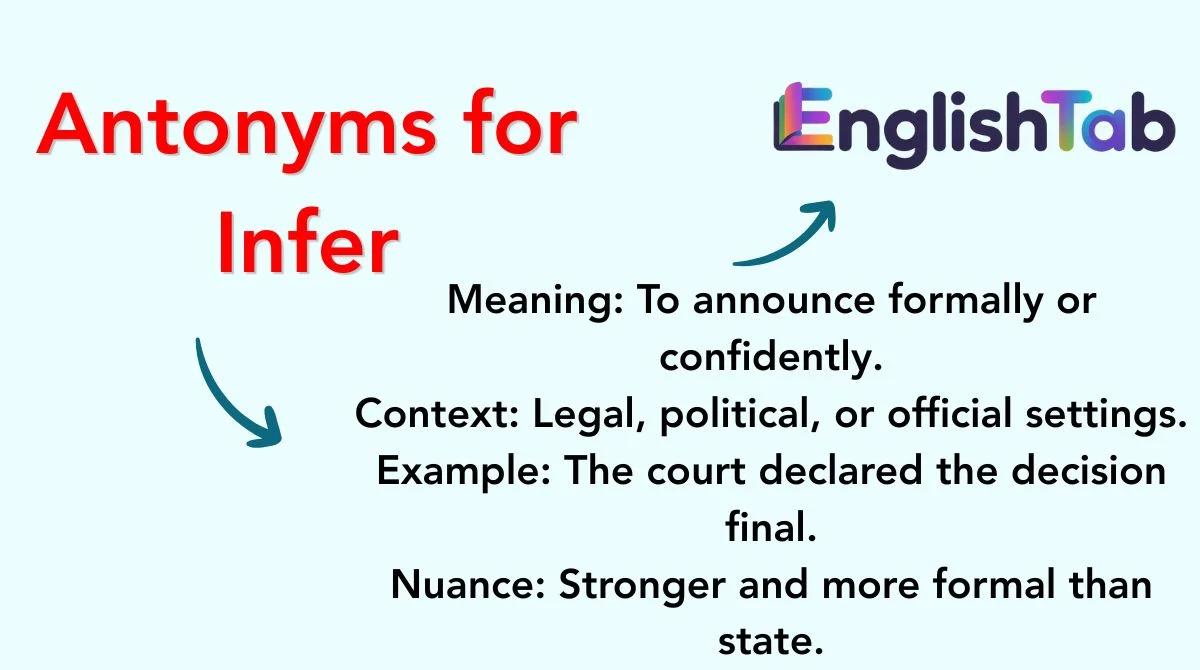
Declare
Meaning: To announce formally or confidently.
Context: Legal, political, or official settings.
Example: The court declared the decision final.
Nuance: Stronger and more formal than state.
Explain
Meaning: To make something clear by giving details.
Context: Educational and instructional writing.
Example: The teacher explained the process step by step.
Nuance: Focuses on clarity rather than deduction.
Clarify
Meaning: To remove confusion.
Context: Correcting misunderstandings.
Example: She clarified her earlier comment.
Nuance: Used when inference may have caused confusion.
Specify
Meaning: To give exact details.
Context: Technical or academic writing.
Example: The contract specifies payment terms.
Nuance: Highly precise, avoids ambiguity.
Assert
Meaning: To state confidently.
Context: Argumentative essays.
Example: The author asserts that climate patterns are changing.
Nuance: Indicates confidence rather than deduction.
Announce
Meaning: To make information public.
Context: Public communication.
Example: The company announced its new policy.
Nuance: Public declaration instead of silent reasoning.
Proclaim
Meaning: To declare publicly with emphasis.
Context: Ceremonial or dramatic contexts.
Example: The leader proclaimed independence.
Nuance: Stronger emotional force than declare.
Reveal
Meaning: To make something previously hidden known.
Context: Research findings.
Example: The study revealed new data.
Nuance: Suggests uncovering, not guessing.
Disclose
Meaning: To make secret information known.
Context: Legal or financial contexts.
Example: The company disclosed its earnings.
Nuance: Formal transparency.
Confirm
Meaning: To verify truth or accuracy.
Context: Scientific or factual contexts.
Example: The test results confirm the hypothesis.
Nuance: Moves from inference to certainty.
Prove
Meaning: To show something is true with evidence.
Context: Logical or mathematical contexts.
Example: The experiment proved the theory correct.
Nuance: Stronger than confirm; implies decisive evidence.
Demonstrate
Meaning: To show clearly through evidence or action.
Context: Academic writing.
Example: The data demonstrate a clear trend.
Nuance: Objective and evidence-based.
Show
Meaning: To make visible or understandable.
Context: Broad usage.
Example: The chart shows population growth.
Nuance: Simple and neutral.
Establish
Meaning: To prove or set firmly.
Context: Research papers.
Example: The findings establish a clear link.
Nuance: Suggests long-term acceptance.
Verify
Meaning: To check accuracy.
Context: Technical and investigative writing.
Example: The journalist verified the facts.
Nuance: Focus on checking rather than assuming.
Affirm
Meaning: To confirm positively.
Context: Formal or supportive tone.
Example: The witness affirmed the statement.
Nuance: Adds positive assurance.
Express
Meaning: To communicate thoughts clearly.
Context: Personal or reflective writing.
Example: She expressed her concerns directly.
Nuance: Emotional communication rather than deduction.
Articulate
Meaning: To speak clearly and effectively.
Context: Academic presentations.
Example: The student articulated her argument well.
Nuance: Emphasizes clarity of communication.
Spell Out
Meaning: To explain in full detail.
Context: Instructional or legal writing.
Example: The guidelines spell out the rules.
Nuance: Eliminates room for inference.
Detail
Meaning: To describe thoroughly.
Context: Reports and analysis.
Example: The report details the procedure.
Nuance: Focus on comprehensive explanation.
Refute
Meaning: To prove wrong.
Context: Academic debate.
Example: The scholar refuted the claim.
Nuance: Directly opposes an inference or claim.
Antonym Comparison Table
| Word | Level of Certainty | Formality | Emotional Tone | Best Used In |
|---|---|---|---|---|
| State | Medium | Neutral | Calm | Reports |
| Declare | High | Formal | Strong | Official contexts |
| Explain | Medium | Neutral | Supportive | Education |
| Clarify | Medium | Neutral | Calming | Corrections |
| Confirm | High | Formal | Neutral | Research |
| Prove | Very High | Formal | Definitive | Logic |
| Demonstrate | High | Academic | Neutral | Essays |
| Reveal | Medium | Neutral | Slightly dramatic | Journalism |
| Verify | High | Formal | Objective | Investigation |
| Refute | High | Academic | Confrontational | Debate |
Academic Writing Examples
Inference:
From the results, we infer a relationship between sleep and memory.
Direct contrast:
The results demonstrate a relationship between sleep and memory.
Inference:
Readers may infer bias in the article.
Direct contrast:
The article explicitly states its position.
Inference:
One could infer dissatisfaction from her tone.
Direct contrast:
She clearly expressed her dissatisfaction.
These shifts change the strength of the claim and reduce ambiguity.
When Not to Replace the Word
You should not replace infer when:
- The conclusion is genuinely indirect.
- Evidence is suggestive, not conclusive.
- You want to signal analytical reasoning.
- You are discussing interpretation itself.
For example:
We infer possible causes, but further research is needed.
Using prove or confirm here would exaggerate certainty.
Practice Exercises
Choose the strongest antonym for infer:
- The scientist did not guess; she ______ the theory with evidence.
- The speaker did not hint; he clearly ______ his position.
- The company did not hide its earnings; it ______ them publicly.
- The lawyer did not assume innocence; she ______ it with documents.
Rewrite these sentences replacing infer with a direct opposite:
- From his silence, we infer disagreement.
- Readers infer that the author disagrees.
- From the pattern, scientists infer climate change.
FAQs
What is the strongest antonym for infer?
Prove and confirm are among the strongest because they imply certainty rather than deduction.
Is “state” always an antonym of infer?
Not always. State opposes infer when information is explicit rather than implied.
Can “deny” be an antonym of infer?
Yes, in argumentative contexts where an inference is rejected or contradicted.
Which antonym works best in academic writing?
Demonstrate, establish, confirm, and clarify are often the most appropriate.
Does replacing infer change tone?
Yes. Words like proclaim or refute introduce emotional intensity, while demonstrate maintains neutrality.
Conclusion
Understanding the opposites of infer strengthens writing clarity and analytical precision. While infer signals reasoning from indirect evidence, its antonyms shift language toward directness, proof, explanation, and confirmation.
Choosing the right opposite depends on context:
- Use demonstrate or establish in academic work.
- Use clarify when correcting misunderstanding.
- Use confirm or verify for factual certainty.
- Use refute in debate.
Mastering these 22+ antonyms allows writers to control tone, strengthen arguments, and eliminate ambiguity. In 2026 and beyond, precision remains the foundation of effective communication.

Dorian Hale is an English language enthusiast and content creator dedicated to making vocabulary and grammar learning simple, engaging, and accessible for everyone.