Strong writing depends on contrast. When we understand opposites, we understand meaning more deeply.
Antonyms sharpen ideas, clarify arguments, and create precision in academic and professional writing.
The word environment is widely used in science, sociology, business, education, and literature.
Because it is so broad, writers often need its opposite to express contrast clearly.
However, there is no single universal antonym for environment. Its opposite changes depending on context — physical, social, emotional, or conceptual.
This article presents 20+ antonyms for environment, grouped and analyzed with academic clarity. You will learn their meanings, usage differences, contextual nuances, and when not to replace the word.
Definition and Core Meaning of “Environment”
The word environment refers to:
- The surroundings or conditions in which a person, animal, or plant lives.
- The physical world (air, land, water, climate).
- Social or cultural surroundings.
- The setting that influences growth, behavior, or development.
At its core, environment suggests external conditions that surround and influence something.
To identify antonyms accurately, we must understand this central idea:
external surroundings or influencing conditions.
Opposites may therefore involve:
- Isolation
- Internal states
- Emptiness
- Absence of conditions
- Artificial separation
- Hostility toward surroundings
Direct Opposites (Clear Contrasts)
These are the strongest and most direct antonyms depending on meaning:
- Isolation
- Void
- Vacuum
- Emptiness
- Barrenness
- Desolation
- Absence
- Separation
- Disconnection
- Interior
- Core
- Self
- Individuality
- Artificiality
- Sterility
- Hostility
- Confinement
- Detachment
- Independence
- Nonexistence
- Nullity
- Exclusion
Each word opposes environment in a distinct conceptual way.
Contextual Opposites
Some words function as antonyms only in certain situations:
- Isolation — opposite when environment implies social surroundings.
- Interior — opposite when environment refers to external space.
- Artificiality — opposite when environment refers to natural systems.
- Independence — opposite when environment implies influence.
- Confinement — opposite when environment suggests openness.
- Void — opposite when environment means populated or active surroundings.
Context determines precision. Academic writing demands this sensitivity.
Emotional & Tone-Based Opposites
Environment often carries neutral or positive connotations, such as:
- Supportive environment
- Healthy environment
- Productive environment
Opposites shift tone dramatically:
- Hostility (emotionally aggressive)
- Desolation (emotionally bleak)
- Barrenness (lifeless)
- Sterility (cold and clinical)
- Void (existential emptiness)
These words intensify emotional contrast, especially in literature or persuasive writing.
20+ Antonyms Explained in Detail
Below are detailed explanations for over twenty antonyms.
Isolation
Meaning: A state of being alone or separated.
Context: Opposes environment when environment implies interaction.
Example: The research emphasized social isolation rather than community environment.
Nuance: Isolation removes surrounding influence; environment implies surrounding impact.
Void
Meaning: An empty space; nothingness.
Context: Opposes environment when referring to populated surroundings.
Example: The abandoned building felt like a void instead of a living environment.
Nuance: Void suggests total absence; environment implies presence.
Vacuum
Meaning: Space entirely devoid of matter.
Context: Scientific contrast to environmental presence.
Example: Life cannot survive in a vacuum without environmental support.
Nuance: Vacuum is technical and literal.
Emptiness
Meaning: Lack of content or life.
Context: Used when environment implies vitality.
Example: The desert’s emptiness contrasted with the lush forest environment.
Nuance: Emptiness is softer than void.
Barrenness
Meaning: Inability to produce life.
Context: Opposes fertile environment.
Example: Soil barrenness prevents a healthy agricultural environment.
Nuance: Focuses on productivity.
Desolation
Meaning: Complete devastation or bleakness.
Context: Emotional opposite of thriving environment.
Example: War turned the city’s vibrant environment into desolation.
Nuance: Strong emotional tone.
Absence
Meaning: Lack of presence.
Context: Opposes environmental influence.
Example: In the absence of a stable environment, growth slows.
Nuance: Abstract and academic.
Separation
Meaning: State of being apart.
Context: Opposes interconnected surroundings.
Example: Emotional separation can weaken a supportive environment.
Nuance: Social dimension.
Disconnection
Meaning: Lack of connection or relationship.
Context: Opposes relational environment.
Example: Digital disconnection harms collaborative environments.
Nuance: Focuses on broken links.
Interior
Meaning: Inner part.
Context: Opposes external environment.
Example: The study analyzed internal psychology rather than external environment.
Nuance: Spatial contrast.
Core
Meaning: Central internal part.
Context: Opposes surrounding outer space.
Example: The core identity differs from environmental influence.
Nuance: Conceptual center vs external.
Self
Meaning: One’s own identity.
Context: Opposes social environment.
Example: Personal choice sometimes overrides environmental pressures.
Nuance: Individual agency.
Individuality
Meaning: Unique personal identity.
Context: Opposes collective environment.
Example: The program values individuality over environmental conformity.
Nuance: Emphasizes uniqueness.
Artificiality
Meaning: Lack of natural authenticity.
Context: Opposes natural environment.
Example: Plastic landscapes reflect artificiality, not true environment.
Nuance: Authenticity dimension.
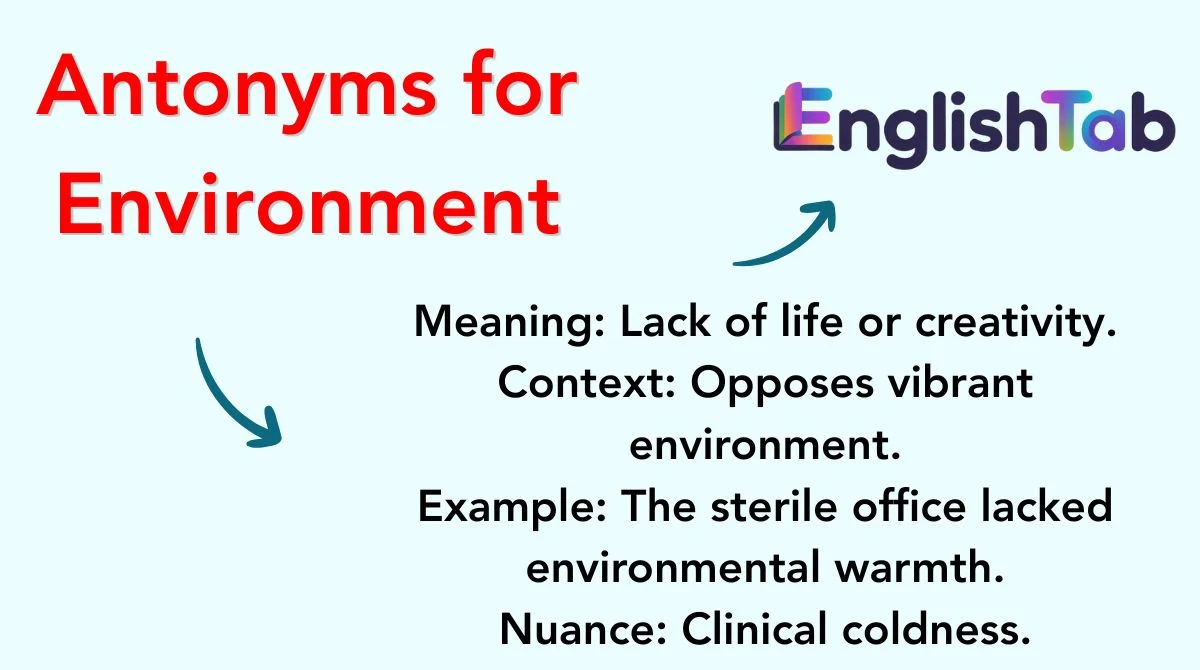
Sterility
Meaning: Lack of life or creativity.
Context: Opposes vibrant environment.
Example: The sterile office lacked environmental warmth.
Nuance: Clinical coldness.
Hostility
Meaning: Aggressive opposition.
Context: Opposes supportive environment.
Example: A hostile workplace undermines productive environment.
Nuance: Emotional aggression.
Confinement
Meaning: Restriction within limits.
Context: Opposes open environment.
Example: Prison confinement limits environmental interaction.
Nuance: Physical restriction.
Detachment
Meaning: Emotional or physical separation.
Context: Opposes immersive environment.
Example: Academic detachment differs from environmental involvement.
Nuance: Psychological separation.
Independence
Meaning: Freedom from external control.
Context: Opposes environmental influence.
Example: The theory highlights independence from environment.
Nuance: Autonomy emphasis.
Nonexistence
Meaning: State of not existing.
Context: Opposes presence of environment.
Example: Without atmosphere, environmental nonexistence prevents life.
Nuance: Absolute absence.
Nullity
Meaning: Nothingness; invalid state.
Context: Opposes meaningful environment.
Example: Emotional nullity contrasts with supportive environment.
Nuance: Legal or philosophical tone.
Exclusion
Meaning: Act of leaving out.
Context: Opposes inclusive environment.
Example: Social exclusion damages educational environment.
Nuance: Social inequality focus.
Antonym Comparison Table
| Antonym | Type of Opposition | Emotional Strength | Best Used In |
|---|---|---|---|
| Isolation | Social separation | Moderate | Sociology |
| Void | Physical absence | Strong | Literature |
| Vacuum | Scientific absence | Neutral | Physics |
| Desolation | Emotional ruin | Very strong | Narrative |
| Artificiality | Natural contrast | Moderate | Environmental studies |
| Sterility | Creative absence | Moderate | Workplace analysis |
| Confinement | Physical limit | Strong | Legal writing |
| Independence | Influence contrast | Neutral | Psychology |
| Barrenness | Fertility absence | Moderate | Agriculture |
| Hostility | Emotional conflict | Strong | HR studies |
Academic Writing Examples
- The study contrasts environmental influence with individual independence.
- Urban isolation disrupts social environments.
- Artificiality replaces natural environment in industrial zones.
- Psychological detachment reduces environmental sensitivity.
- Hostility within organizations destroys collaborative environments.
When Not to Replace the Word
Avoid replacing environment when:
- Referring to ecological systems in scientific writing.
- Using legal terminology (e.g., environmental law).
- Discussing climate or sustainability.
- The context requires neutrality.
Some antonyms change meaning drastically. For example:
- Replacing environment with void introduces existential tone.
- Using hostility shifts toward emotional conflict.
- Substituting interior changes spatial meaning entirely.
Precision matters.
Practice Exercises
- Replace “environment” with an appropriate antonym:
The supportive classroom environment improved performance. - Choose the stronger contrast:
thriving environment vs. ____ (barrenness / detachment) - Identify contextual accuracy:
The experiment removed environmental variables, creating a ____. - Write a sentence contrasting individuality and environment.
- Which antonym best opposes natural environment in urban studies?
FAQs
What is the strongest antonym for environment?
There is no single strongest antonym. Void and isolation are among the most direct depending on context.
Can independence be an antonym for environment?
Yes, when environment refers to external influence, independence acts as a conceptual opposite.
Is interior always the opposite of environment?
Only when environment refers to external surroundings.
Why does context matter when choosing antonyms?
Because environment has multiple meanings — physical, social, emotional — and each requires a different type of contrast.
Are void and vacuum interchangeable?
Not entirely. Vacuum is scientific; void is broader and often literary.
Conclusion
The word environment carries layered meanings — physical surroundings, social systems, psychological influence, and ecological context.
Because of this complexity, its antonyms are equally nuanced.
We examined more than twenty antonyms, grouped into direct, contextual, and emotional categories.
Words such as isolation, void, barrenness, artificiality, and independence reveal different dimensions of opposition.
Effective writing demands precision. Choosing the right antonym strengthens argument clarity, enhances contrast, and improves academic depth.
Understanding opposites is not merely vocabulary expansion — it is conceptual mastery.

Dorian Hale is an English language enthusiast and content creator dedicated to making vocabulary and grammar learning simple, engaging, and accessible for everyone.