Precision in vocabulary determines clarity in academic and professional writing. When writers misunderstand whether two words are synonyms or antonyms, meaning becomes distorted.
Words such as firebrand and radical often appear interchangeable, especially in political, social, or ideological discussions. However, the relationship between them is more nuanced than it initially seems.
Understanding opposites is not merely a dictionary exercise. Oppositional vocabulary sharpens argument structure, strengthens contrast paragraphs, and prevents conceptual confusion.
In critical analysis, knowing whether terms align or diverge allows scholars to present balanced perspectives.
So, are firebrand and radical synonyms or antonyms? The answer depends on context, intensity, and tone.
This article provides a detailed contrast analysis, offering 16+ antonyms, contextual distinctions, emotional comparisons, and academic applications.
Definition and Core Meaning of “Firebrand” and “Radical”
Firebrand
A firebrand refers to a person who is passionately outspoken, provocative, and often agitates for change. The term suggests emotional intensity and sometimes inflammatory rhetoric. A firebrand does not simply advocate change; they stir public reaction.
Core traits:
- Highly vocal
- Confrontational
- Emotionally charged
- Often polarizing
Example:
The senator became known as a firebrand after delivering several explosive speeches.
Radical
A radical refers to someone who supports fundamental or extreme change, especially in political or social systems. Unlike firebrand, radical emphasizes depth of ideological transformation rather than tone of delivery.
Core traits:
- Supports fundamental change
- Ideologically transformative
- Can be calm or intense
- Focused on structural reform
Example:
The activist proposed radical reforms to restructure the education system.
Are They Synonyms or Antonyms?
They are partial synonyms in some contexts, but not complete equivalents.
- When referring to political activism, both can overlap.
- However, firebrand emphasizes personality and emotional style.
- Radical emphasizes ideological depth and systemic change.
They are not antonyms. Instead, they share conceptual territory while differing in tone and scope.
Direct Opposites (Clear Contrasts)
Below are 16 strong antonyms that directly oppose the combined spirit of firebrand and radical:
Moderate
Conservative
Traditionalist
Conformist
Centrist
Cautious
Pragmatist
Diplomat
Reconciler
Conventionalist
Status-quo supporter
Incrementalist
Peacemaker
Harmonizer
Stabilizer
Orthodox thinker
These words reflect restraint, stability, and resistance to extreme or provocative change.
Contextual Opposites
Certain words function as opposites depending on situation:
Realist – Opposes radical idealism but may still support change.
Technocrat – Prefers technical solutions over emotional agitation.
Institutionalist – Supports structured reform rather than disruptive activism.
Gradualist – Accepts change but rejects extremity.
Traditional reformer – Modifies systems without dismantling them.
Context determines whether these words truly oppose firebrand or radical. For example, a realist might still propose reforms but avoid emotional rhetoric.
Emotional & Tone-Based Opposites
Firebrand carries high emotional intensity. Radical may carry ideological seriousness. Emotional opposites include:
Reserved
Calm
Composed
Diplomatic
Measured
Detached
Neutral
Dispassionate
A firebrand excites; a diplomat reassures. A radical challenges systems; a gradualist modifies them carefully.
16+ Antonyms Explained in Detail
Moderate
Meaning: Avoiding extremes.
Context: Political or social discussions.
Example: She presented a moderate proposal acceptable to both parties.
Nuance: Moderate suggests balance, unlike radical which seeks structural overhaul.
Conservative
Meaning: Favoring tradition and stability.
Context: Political ideology.
Example: The conservative leader opposed sweeping reforms.
Nuance: Conservative resists change; radical demands it.
Traditionalist
Meaning: Upholds long-standing customs.
Context: Cultural debates.
Example: The traditionalist argued against altering the ceremony.
Nuance: A traditionalist protects the past; a firebrand disrupts it.
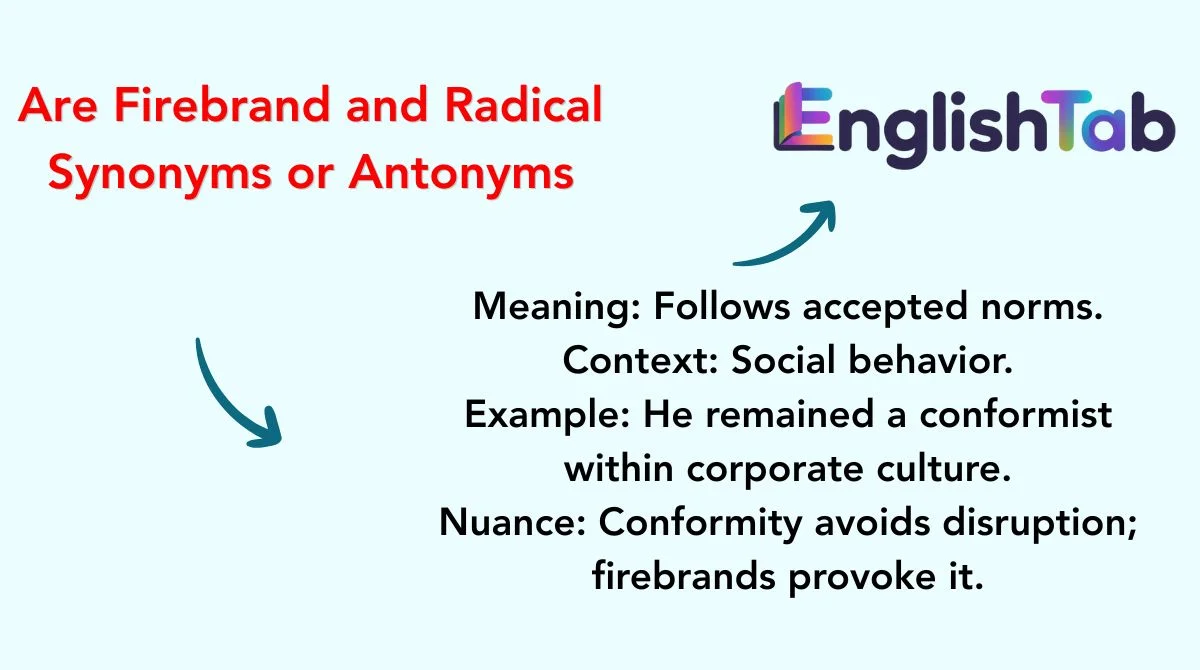
Conformist
Meaning: Follows accepted norms.
Context: Social behavior.
Example: He remained a conformist within corporate culture.
Nuance: Conformity avoids disruption; firebrands provoke it.
Centrist
Meaning: Occupying middle ground.
Context: Political spectrum.
Example: The centrist candidate appealed to undecided voters.
Nuance: Centrism balances extremes; radicalism challenges them.
Cautious
Meaning: Careful and risk-averse.
Context: Policy development.
Example: The board adopted a cautious investment strategy.
Nuance: Firebrands embrace confrontation; cautious actors avoid it.
Pragmatist
Meaning: Focused on practical outcomes.
Context: Governance and reform.
Example: As a pragmatist, she supported small, workable changes.
Nuance: Radical aims for ideological purity; pragmatist prioritizes feasibility.
Diplomat
Meaning: Skilled in negotiation and tact.
Context: Conflict resolution.
Example: He acted as a diplomat during heated debates.
Nuance: Diplomatic tone contrasts with firebrand intensity.
Reconciler
Meaning: Brings opposing sides together.
Context: Social or political conflict.
Example: The reconciler reduced tensions within the movement.
Nuance: Firebrands escalate; reconcilers de-escalate.
Conventionalist
Meaning: Follows established practices.
Example: The conventionalist rejected experimental ideas.
Nuance: Radical thought often rejects convention entirely.
Status-quo supporter
Meaning: Defends existing systems.
Example: She remained a status-quo supporter in policy debates.
Nuance: Radical seeks transformation; status-quo supporter resists it.
Incrementalist
Meaning: Supports gradual progress.
Example: The incrementalist introduced reform step by step.
Nuance: Radical demands fundamental change immediately.
Peacemaker
Meaning: Promotes harmony.
Example: He acted as a peacemaker in heated discussions.
Nuance: Firebrand may inflame; peacemaker soothes.
Harmonizer
Meaning: Encourages unity and cohesion.
Example: The harmonizer emphasized collaboration.
Nuance: Emotional tone sharply differs from provocative rhetoric.
Stabilizer
Meaning: Maintains balance and order.
Example: Economic policies aimed to serve as stabilizers.
Nuance: Radical shifts systems; stabilizer preserves equilibrium.
Orthodox thinker
Meaning: Follows established doctrines.
Example: The orthodox thinker resisted new theoretical models.
Nuance: Radical often rejects orthodoxy altogether.
Antonym Comparison Table
| Word | Change Level | Emotional Tone | System Impact | Risk Level |
|---|---|---|---|---|
| Moderate | Low | Calm | Minor adjustment | Low |
| Conservative | Very low | Restrained | Preservation | Low |
| Pragmatist | Medium | Measured | Practical reform | Controlled |
| Diplomat | Low | Tactful | Negotiated | Low |
| Incrementalist | Gradual | Calm | Stepwise reform | Managed |
| Peacemaker | Minimal | Harmonizing | Stability | Low |
| Centrist | Balanced | Neutral | Compromise | Moderate |
| Status-quo supporter | None | Stable | Preservation | Low |
Academic Writing Examples
Contrast paragraph:
While the activist’s firebrand rhetoric energized the crowd, the committee preferred a moderate and pragmatic strategy for reform.
Comparative analysis:
Although radical reformers advocate structural transformation, incrementalists argue that sustainable progress requires gradual implementation.
Critical evaluation:
The firebrand’s approach generated immediate visibility; however, diplomatic engagement achieved long-term institutional change.
When Not to Replace the Word
Avoid replacing firebrand with radical when:
- The focus is emotional tone rather than ideology.
- The subject agitates publicly but lacks deep systemic goals.
- The description concerns personality rather than policy.
Avoid replacing radical with firebrand when:
- Discussing theoretical frameworks.
- Referring to philosophical transformation.
- Describing structural change without emotional agitation.
Precision matters in scholarly discourse.
Practice Exercises
- Replace the underlined word with the most accurate antonym:
The firebrand speaker criticized the institution aggressively. - Choose the best opposite for radical in academic reform context.
- Rewrite:
The radical proposal shocked the council.
Make it gradual in tone. - Identify whether the sentence emphasizes tone or ideology:
Her speeches were fiery but lacked structural reform plans. - Compare moderate and incrementalist in one sentence.
FAQs
Are firebrand and radical complete synonyms?
No. They overlap in reform contexts but differ in tone and emphasis.
Can a person be both a firebrand and a radical?
Yes. An activist can advocate fundamental change while using provocative rhetoric.
Is radical always negative?
Not necessarily. In academic contexts, radical can mean foundational or transformative without negative implication.
Is firebrand always political?
No. It can describe any outspoken agitator in social, corporate, or cultural environments.
Which word is stronger emotionally?
Firebrand typically carries stronger emotional intensity.
Conclusion
Firebrand and radical are not antonyms. They are partial synonyms with distinct emphases.
Firebrand highlights emotional intensity and provocative personality, while radical emphasizes deep structural transformation.
Their antonyms—such as moderate, conservative, pragmatist, diplomat, and incrementalist—represent stability, restraint, and gradualism.
Mastering these distinctions enhances clarity in analytical writing, strengthens argumentative precision, and prevents conceptual overlap.
In 2K26 and beyond, linguistic precision remains central to academic excellence.

Dorian Hale is an English language enthusiast and content creator dedicated to making vocabulary and grammar learning simple, engaging, and accessible for everyone.