Clear writing depends on precision. One of the most powerful tools for achieving clarity is contrast. When writers understand opposites, they sharpen meaning.
They reduce confusion. They strengthen arguments.
The verb allude often appears in academic, literary, and formal contexts. It signals subtlety. It suggests indirect reference.
But strong communication does not always require subtlety. Sometimes clarity demands directness.
Understanding allude antonyms helps writers decide when to be indirect and when to be explicit.
This article provides 22+ carefully explained antonyms of allude, explores contextual and emotional contrasts, and offers academic comparisons for precise usage.
Definition and Core Meaning of “Allude”
Allude means to refer to something indirectly, often without stating it openly.
Writers use it when they hint at an idea rather than express it clearly. The reference may rely on shared knowledge, cultural background, or subtle suggestion.
Example:
- The professor alluded to a famous legal case without naming it.
Key characteristics of allude:
- Indirect
- Subtle
- Implied
- Suggestive
- Often incomplete
Because it avoids direct expression, its opposites usually involve clarity, openness, or explicit communication.
Direct Opposites (Clear Contrasts)
Below are 22 of the strongest antonyms of allude. These words directly oppose the idea of indirect reference.
state
declare
announce
specify
explain
clarify
express
articulate
identify
name
spell out
detail
reveal
disclose
pronounce
affirm
assert
proclaim
define
outline
report
communicate
Each of these verbs replaces subtle hinting with direct expression.
Contextual Opposites
Some words act as antonyms of allude depending on the situation. These do not always mean the opposite, but they often contrast in context.
- confront – direct engagement rather than indirect hinting
- confess – open admission instead of suggestion
- expose – bring fully into view
- publicize – widely share instead of quietly imply
- testify – provide formal direct evidence
- elaborate – expand clearly rather than hint
In academic writing, these contextual opposites shift tone from subtle implication to deliberate exposition.
Emotional & Tone-Based Opposites
Alluding is usually cautious and restrained. Some antonyms differ not only in meaning but also in emotional force.
Subtle → Direct
Hinting → Forceful
Reserved → Bold
Suggestive → Transparent
For example:
- To allude is calm and controlled.
- To proclaim carries intensity and confidence.
- To expose suggests urgency or even aggression.
- To assert signals authority.
Thus, choosing an antonym changes not only clarity but also tone.
22+ Antonyms Explained in Detail
Below is a deep comparison of 22 antonyms. Each includes meaning, context, example, and nuance difference.
State
Meaning: To express something clearly in words.
Context: Formal writing and factual communication.
Example: The author stated the theory directly.
Nuance: Neutral clarity without emotional force.
Declare
Meaning: To announce formally or publicly.
Context: Official or legal settings.
Example: The judge declared the verdict.
Nuance: Stronger and more authoritative than state.
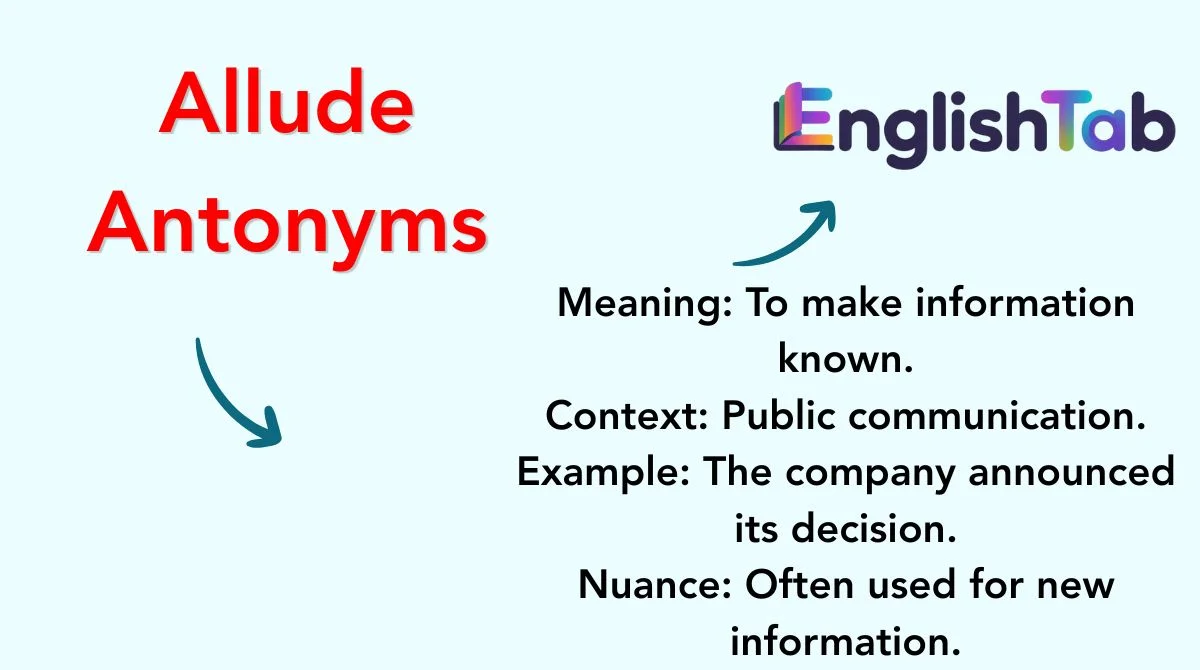
Announce
Meaning: To make information known.
Context: Public communication.
Example: The company announced its decision.
Nuance: Often used for new information.
Specify
Meaning: To describe exactly.
Context: Technical or academic writing.
Example: The instructions specify each step.
Nuance: Focus on precision and detail.
Explain
Meaning: To make something clear by describing it.
Context: Teaching and academic writing.
Example: The teacher explained the concept.
Nuance: Implies fuller understanding.
Clarify
Meaning: To remove confusion.
Context: Editing and academic discussion.
Example: The speaker clarified his point.
Nuance: Focus on eliminating misunderstanding.
Express
Meaning: To convey thoughts or feelings directly.
Context: Both formal and informal.
Example: She expressed concern.
Nuance: Broader than state; includes emotion.
Articulate
Meaning: To speak clearly and effectively.
Context: Academic and rhetorical writing.
Example: He articulated his argument carefully.
Nuance: Suggests skill and precision.
Identify
Meaning: To name or recognize clearly.
Context: Analytical writing.
Example: The researcher identified key variables.
Nuance: Focus on recognition.
Name
Meaning: To mention directly.
Context: Simple direct reference.
Example: She named the problem.
Nuance: Basic and straightforward.
Spell Out
Meaning: To explain in detail.
Context: Instructional writing.
Example: The contract spells out the rules.
Nuance: Emphasizes complete clarity.
Detail
Meaning: To describe fully.
Context: Reports and academic papers.
Example: The report details the findings.
Nuance: Structured explanation.
Reveal
Meaning: To make known something hidden.
Context: Journalism and research.
Example: The study revealed new evidence.
Nuance: Suggests prior secrecy.
Disclose
Meaning: To open to view formally.
Context: Legal and professional communication.
Example: The company disclosed financial data.
Nuance: Controlled transparency.
Pronounce
Meaning: To declare officially.
Context: Ceremonial or legal language.
Example: The court pronounced the sentence.
Nuance: Formal authority.
Affirm
Meaning: To confirm or support openly.
Context: Academic argument.
Example: The data affirms the hypothesis.
Nuance: Positive reinforcement.
Assert
Meaning: To state confidently.
Context: Debate and argument.
Example: She asserted her claim strongly.
Nuance: Suggests confidence or insistence.
Proclaim
Meaning: To announce publicly with emphasis.
Context: Political or dramatic writing.
Example: The leader proclaimed victory.
Nuance: High emotional intensity.
Define
Meaning: To explain meaning clearly.
Context: Academic texts.
Example: The article defines key terms.
Nuance: Concept-focused clarity.
Outline
Meaning: To summarize main points clearly.
Context: Structured writing.
Example: The introduction outlines the argument.
Nuance: Organized presentation.
Report
Meaning: To present information factually.
Context: Journalism and research.
Example: The study reports significant changes.
Nuance: Neutral documentation.
Communicate
Meaning: To share information clearly.
Context: General formal writing.
Example: The memo communicates policy changes.
Nuance: Broad and neutral.
Antonym Comparison Table
| Word | Directness Level | Emotional Intensity | Formality | Best Used In |
|---|---|---|---|---|
| State | High | Low | Formal | Academic |
| Declare | Very High | Medium | Formal | Legal |
| Announce | High | Medium | Neutral | Public |
| Specify | Very High | Low | Technical | Manuals |
| Explain | High | Low | Neutral | Teaching |
| Reveal | High | Medium | Neutral | Journalism |
| Assert | High | Medium | Formal | Argument |
| Proclaim | Very High | High | Dramatic | Political |
| Define | Very High | Low | Academic | Research |
| Clarify | High | Low | Neutral | Editing |
Academic Writing Examples
Indirect approach:
The author alludes to previous research without citing it directly.
Direct replacement examples:
The author states the findings of previous research clearly.
The author defines the central concept before analysis.
The researcher specifies the variables in measurable terms.
The article discloses funding sources transparently.
Notice how replacing allude increases precision and reduces ambiguity. Academic writing often favors clarity over suggestion.
When Not to Replace the Word
Do not replace allude when:
- Subtlety is intentional
- Literary tone requires suggestion
- Cultural references are implied
- The effect depends on reader inference
In poetry and narrative essays, direct language may weaken stylistic depth. Allusion can enrich interpretation.
Practice Exercises
Rewrite each sentence using a strong antonym of allude.
- The speaker alluded to financial problems.
- The essay alludes to social injustice.
- The professor alluded to the answer.
- The report alluded to policy failures.
- The writer alluded to historical conflict.
Suggested direction: replace with declare, explain, disclose, define, or specify.
FAQs
What is the strongest antonym of allude?
There is no single strongest antonym, but state, declare, and specify provide the clearest direct contrast.
Is “mention” an antonym of allude?
Not exactly. Mention can still be brief or indirect. It is less forceful than state or explain.
Can allude be replaced in academic writing?
Yes, often. Academic writing usually prefers clarity. Words like define, specify, or state improve precision.
Are emotional antonyms important?
Yes. Words like proclaim or assert change tone as well as meaning.
Conclusion
Understanding allude antonyms strengthens writing clarity. While allude offers subtlety and suggestion, its opposites deliver precision, authority, and transparency.
Writers must choose between indirect implication and direct communication based on purpose, audience, and tone. Academic contexts favor clarity. Literary contexts may prefer suggestion.
Mastering these 22+ antonyms allows you to control meaning deliberately.
Instead of hinting, you can declare. Instead of implying, you can define. Instead of suggesting, you can specify.
Clarity is power.

Dorian Hale is an English language enthusiast and content creator dedicated to making vocabulary and grammar learning simple, engaging, and accessible for everyone.