In academic and technical writing, clarity often depends not only on defining a concept but also on understanding what it is not.
Opposites sharpen meaning. When a writer contrasts an idea with its antonym, the boundaries of interpretation become clearer, more precise, and intellectually robust.
The term algorithm occupies a central place in computer science, mathematics, artificial intelligence, and digital systems. Yet, outside its formal definition, it is frequently misunderstood or overextended.
By studying its antonyms, we illuminate its defining properties: structure, determinism, repeatability, and logical progression.
This article presents 19+ algorithm antonyms, categorized and analyzed with academic rigor. Each term is explained in depth, compared in nuance, and contextualized for scholarly writing.
Definition and Core Meaning of “Algorithm”
An algorithm is a finite, well-defined sequence of instructions designed to perform a task or solve a problem. Its essential characteristics include:
- Step-by-step structure
- Logical order
- Deterministic or rule-based execution
- Predictable outcome (under defined conditions)
- Replicability
In computational terms, an algorithm transforms input into output through systematic procedures. In broader contexts, it may refer to structured methods in decision-making, optimization, or analysis.
To identify true antonyms, we must isolate what makes an algorithm distinct: order, rule-governed logic, and procedural clarity.
Direct Opposites (Clear Contrasts)
The strongest antonyms directly negate core features of an algorithm: structure, order, predictability, and rule-based logic.
The 19 strongest antonyms include:
Randomness
Chaos
Improvisation
Intuition
Guesswork
Disorder
Spontaneity
Anarchy
Unpredictability
Instinct
Confusion
Ambiguity
Arbitrariness
Haphazardness
Disorganization
Accident
Coincidence
Impulse
Inconsistency
Each of these terms removes one or more defining properties of algorithmic structure.
Contextual Opposites
Some words function as antonyms only in specific settings. For example:
Creativity may oppose algorithm when structured rules limit imaginative thinking.
Flexibility contrasts with rigid algorithmic processes.
Subjectivity counters objective algorithmic logic.
Heuristics may oppose strict algorithm when solutions are approximate rather than guaranteed.
In computational research, a heuristic is not always an antonym—but in philosophical discussions about certainty and structure, it can function as one.
Emotional & Tone-Based Opposites
Algorithms imply neutrality, control, and precision. Emotional antonyms shift tone dramatically.
Cold logic vs passionate impulse
Measured process vs chaotic reaction
Structured reasoning vs emotional decision
Words like impulse, instinct, and spontaneity introduce emotional intensity that algorithms deliberately exclude. Tone differences can reshape argument strength and rhetorical emphasis.
19+ Antonyms Explained in Detail
Randomness
Meaning: Lack of pattern or predictable order.
Context: Used in mathematics, statistics, or philosophy.
Example: The results were driven by randomness rather than a structured method.
Nuance: Randomness eliminates intention and repeatability, while algorithms depend on both.
Chaos
Meaning: Complete disorder and unpredictability.
Context: Organizational or theoretical discussions.
Example: Without procedural rules, the system descended into chaos.
Nuance: Chaos implies breakdown; algorithm implies controlled progression.
Improvisation
Meaning: Creating spontaneously without pre-planning.
Context: Arts, management, or crisis response.
Example: The team relied on improvisation instead of a formal process.
Nuance: Improvisation can be intelligent, but it lacks predefined structure.
Intuition
Meaning: Immediate understanding without reasoning.
Context: Psychology, philosophy.
Example: She solved the issue by intuition, not by stepwise analysis.
Nuance: Intuition bypasses explicit steps; algorithms require them.
Guesswork
Meaning: Conclusions without sufficient evidence.
Context: Academic criticism.
Example: The study avoided guesswork by applying a formal computational model.
Nuance: Guesswork implies uncertainty; algorithm implies systematic reliability.
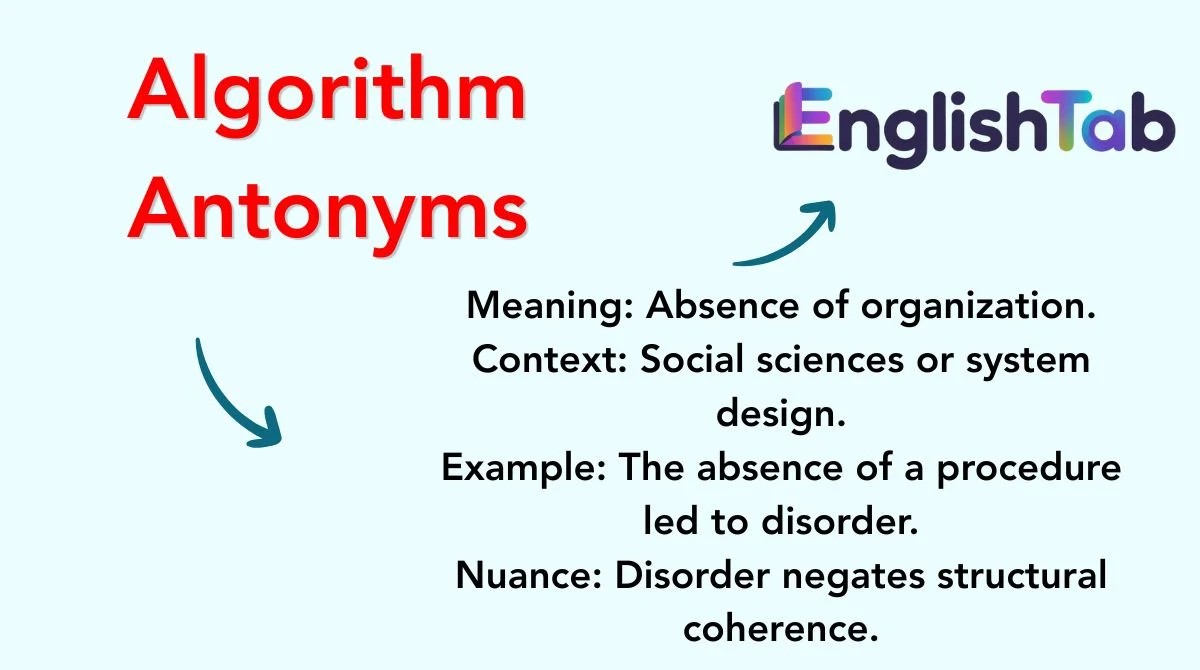
Disorder
Meaning: Absence of organization.
Context: Social sciences or system design.
Example: The absence of a procedure led to disorder.
Nuance: Disorder negates structural coherence.
Spontaneity
Meaning: Acting without prior planning.
Context: Behavioral analysis.
Example: Human spontaneity resists algorithmic prediction.
Nuance: Spontaneity may be creative; algorithm prioritizes predefinition.
Anarchy
Meaning: Lack of governing principles.
Context: Political theory or metaphorical use.
Example: Decision-making devolved into anarchy without guidelines.
Nuance: An algorithm imposes governance through rules.
Unpredictability
Meaning: Inability to forecast outcomes.
Context: Risk analysis.
Example: The market displayed unpredictability beyond algorithmic modeling.
Nuance: Algorithms strive for predictability within defined parameters.
Instinct
Meaning: Natural, automatic response.
Context: Evolutionary psychology.
Example: The pilot acted on instinct rather than procedure.
Nuance: Instinct is biological; algorithm is constructed logic.
Confusion
Meaning: Lack of clarity or understanding.
Context: Academic critique.
Example: Clear instructions replaced confusion in the revised model.
Nuance: Algorithms reduce ambiguity; confusion amplifies it.
Ambiguity
Meaning: Multiple possible interpretations.
Context: Linguistics, law.
Example: The algorithm eliminated ambiguity in classification.
Nuance: Algorithms require explicit instructions; ambiguity undermines them.
Arbitrariness
Meaning: Based on random choice or personal whim.
Context: Legal or ethical discussion.
Example: The policy avoided arbitrariness through standardized procedures.
Nuance: Arbitrariness rejects systematic logic.
Haphazardness
Meaning: Lacking careful planning.
Context: Organizational analysis.
Example: Haphazardness reduced efficiency.
Nuance: Algorithms maximize systematic precision.
Disorganization
Meaning: Poor arrangement or planning.
Context: Management.
Example: The project failed due to disorganization.
Nuance: Algorithm implies ordered sequencing.
Accident
Meaning: Unintended event.
Context: Causal analysis.
Example: The breakthrough was an accident, not a computed result.
Nuance: Algorithms minimize accident through planning.
Coincidence
Meaning: Simultaneous occurrence without causal planning.
Context: Probability theory.
Example: The alignment was coincidence rather than programmed design.
Nuance: Coincidence lacks intentional sequence.
Impulse
Meaning: Sudden urge without reasoning.
Context: Behavioral economics.
Example: Impulse buying contradicts algorithmic budgeting models.
Nuance: Impulse is immediate; algorithm is deliberate.
Inconsistency
Meaning: Lack of uniformity.
Context: Research methodology.
Example: The method reduced inconsistency across trials.
Nuance: Algorithms enforce consistent procedures.
Antonym Comparison Table
| Antonym | Removes Structure | Removes Predictability | Emotional Tone | Context Strength |
|---|---|---|---|---|
| Randomness | Yes | Yes | Neutral | Strong |
| Chaos | Yes | Yes | Intense | Very Strong |
| Improvisation | Partial | Partial | Creative | Moderate |
| Intuition | Yes | Partial | Reflective | Moderate |
| Guesswork | Yes | Yes | Weak | Strong |
| Spontaneity | Partial | Yes | Positive | Moderate |
| Arbitrariness | Yes | Yes | Critical | Strong |
| Confusion | Yes | Yes | Negative | Strong |
| Instinct | Yes | Partial | Natural | Moderate |
Academic Writing Examples
- The experimental protocol relied on a clearly defined algorithm rather than intuition.
- Unlike chaos-driven responses, computational systems follow algorithmic order.
- The study eliminated arbitrariness by implementing a reproducible decision sequence.
- Policy decisions based on impulse often conflict with algorithmic optimization models.
- The framework reduced ambiguity through systematic procedural design.
These examples demonstrate how antonyms sharpen analytical contrast.
When Not to Replace the Word
Avoid replacing algorithm when:
- Referring to formal computer science definitions
- Discussing specific named procedures (e.g., sorting models)
- Describing deterministic computational logic
- Writing in technical programming documentation
Using antonyms in these contexts may distort meaning rather than clarify it.
Practice Exercises
- Replace algorithm with a suitable antonym:
The manager made decisions based on ______ rather than structured analysis. - Identify which word best contrasts with algorithm in scientific writing:
a) Creativity
b) Guesswork
c) Optimization - Rewrite this sentence using a strong antonym:
The system operated through a defined algorithm. - Explain the nuance difference between spontaneity and chaos.
- Choose three antonyms and construct academic comparison sentences.
FAQs
What is the strongest antonym of algorithm?
Chaos and randomness are typically the strongest because they negate structure and predictability entirely.
Is intuition always an antonym of algorithm?
Not always. In some hybrid systems, intuitive heuristics complement algorithmic logic rather than oppose it.
Can creativity be an antonym?
In rigid computational contexts, yes. In broader problem-solving discussions, creativity may coexist with algorithms.
Why are antonyms important in academic writing?
They clarify conceptual boundaries and prevent definitional vagueness.
Are heuristics antonyms of algorithms?
Only partially. Heuristics are approximate methods, while algorithms aim for formal, stepwise precision.
Conclusion
Understanding algorithm antonyms deepens conceptual clarity.
By analyzing words such as randomness, chaos, intuition, and arbitrariness, we expose the defining pillars of algorithmic logic: order, structure, repeatability, and determinism.
In scholarly discourse, contrast is not decorative—it is analytical. When writers precisely select antonyms, they refine arguments and prevent conceptual confusion.
The 19+ antonyms explored here provide a structured framework for nuanced academic writing in 2026 and beyond.
Clear contrasts create clearer thinking.

Dorian Hale is an English language enthusiast and content creator dedicated to making vocabulary and grammar learning simple, engaging, and accessible for everyone.