Many people search for “gained knowledge synonyms” when they want better words for essays, resumes, reports, or even daily conversations.
The phrase gained knowledge is clear, but it can feel plain or repetitive. Writers often need stronger, softer, or more formal options depending on the situation.
Using the right synonym improves clarity and makes writing more engaging. In academic work, varied vocabulary shows depth.
In professional settings, it reflects confidence and precision. In casual writing, it keeps language natural and interesting.
Word variety is not about sounding complicated. It is about choosing the best word for the message.
A student writing an IELTS essay, a job seeker updating a resume, or a blogger crafting content can all benefit from richer alternatives.
This complete 2026 guide gives you more than 19 powerful synonyms for gained knowledge, plus tips on when and how to use them correctly.
What Does “Gained Knowledge” Mean?
Gained knowledge means learning or acquiring information, skills, facts, or understanding through study, experience, or observation.
It usually describes a process. Someone starts without certain information and then learns it over time.
Tone Explanation
The phrase is:
- Neutral
- Slightly formal
- Common in academic and professional writing
When It Is Commonly Used
People often use it in:
- Academic essays
- Research papers
- Training reports
- Resume summaries
- Workplace evaluations
Example:
She gained knowledge about digital marketing during her internship.
While correct, this phrase can sound repetitive. That is why better synonyms can improve your writing.
19+ Best Synonyms for “Gained Knowledge”
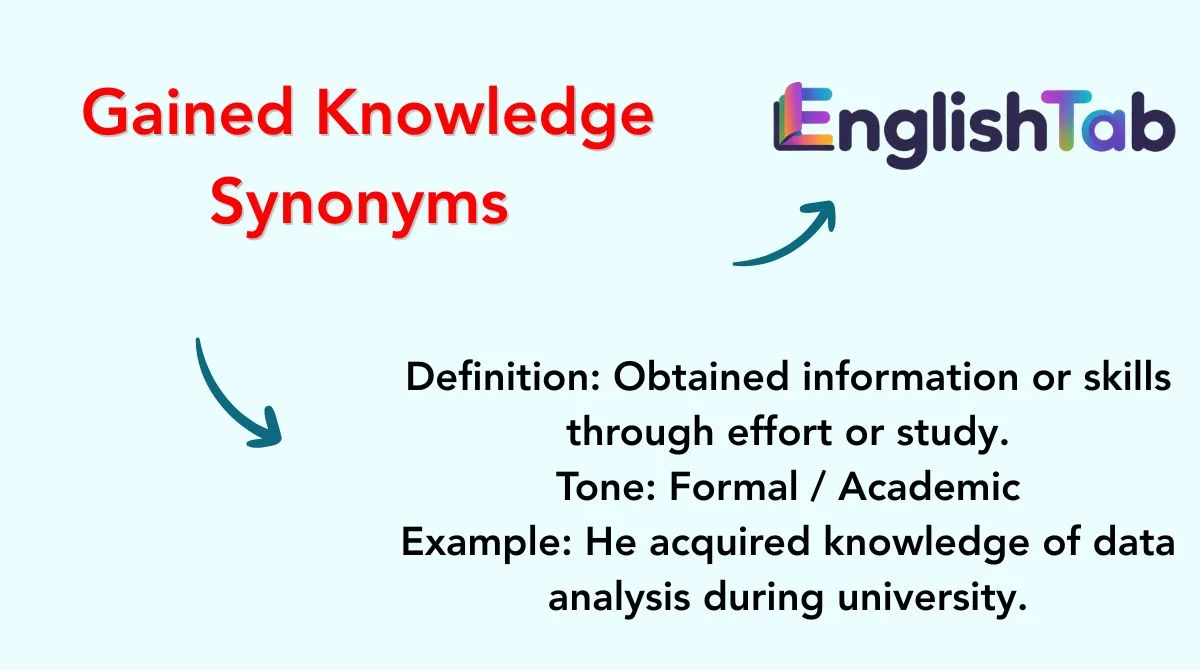
1. Acquired Knowledge
Definition: Obtained information or skills through effort or study.
Tone: Formal / Academic
Example: He acquired knowledge of data analysis during university.
2. Learned
Definition: Became aware of something through study or experience.
Tone: Neutral / Casual
Example: She learned new coding skills last year.
3. Absorbed
Definition: Took in information gradually.
Tone: Literary / Informal
Example: The children absorbed new vocabulary quickly.
4. Attained Understanding
Definition: Reached a clear level of comprehension.
Tone: Formal
Example: He attained understanding of complex legal systems.
5. Developed Expertise
Definition: Built advanced skill in a subject.
Tone: Professional
Example: She developed expertise in financial planning.
6. Mastered
Definition: Learned something completely.
Tone: Strong / Confident
Example: He mastered advanced mathematics in college.
7. Picked Up
Definition: Learned informally or quickly.
Tone: Casual
Example: She picked up basic Spanish while traveling.
8. Gained Insight
Definition: Achieved deeper understanding.
Tone: Academic / Professional
Example: The study helped researchers gain insight into climate change.
9. Expanded Knowledge
Definition: Increased existing understanding.
Tone: Neutral
Example: The course expanded my knowledge of history.
10. Built Knowledge
Definition: Grew understanding step by step.
Tone: Professional
Example: He built knowledge through years of fieldwork.
11. Cultivated Understanding
Definition: Carefully developed deeper awareness.
Tone: Literary / Academic
Example: She cultivated understanding of cultural traditions.
12. Earned Knowledge
Definition: Gained through effort or hard work.
Tone: Formal
Example: He earned knowledge through years of research.
13. Secured Expertise
Definition: Successfully obtained professional skill.
Tone: Formal
Example: She secured expertise in cybersecurity.
14. Gathered Information
Definition: Collected facts or data.
Tone: Neutral
Example: The team gathered information from surveys.
15. Attained Knowledge
Definition: Successfully reached a learning goal.
Tone: Academic
Example: Students attained knowledge through practical labs.
16. Deepened Understanding
Definition: Improved clarity about a subject.
Tone: Academic
Example: Workshops deepened their understanding of leadership.
17. Internalized
Definition: Made knowledge part of one’s thinking.
Tone: Formal / Psychological
Example: She internalized the training principles.
18. Studied
Definition: Learned through focused reading or practice.
Tone: Neutral
Example: He studied business law at university.
19. Informed Himself/Herself
Definition: Actively learned about a topic.
Tone: Semi-formal
Example: She informed herself about health policies.
20. Educated
Definition: Received formal learning.
Tone: Neutral / Formal
Example: He educated himself on investment strategies.
Stronger Alternatives (More Intense Options)
These words show deeper mastery or authority.
- Mastered – Use when skill is complete.
- Commanded – Shows authority over a subject.
- Specialized in – Indicates focused expertise.
- Perfected – Suggests near flawlessness.
- Excelled in – Shows high achievement.
- Conquered – Informal but powerful.
- Internalized – Suggests deep mental adoption.
Use these in resumes, achievements, or when highlighting success.
Softer or Polite Alternatives
These options sound humble or gradual.
- Became familiar with
- Improved understanding of
- Explored
- Reviewed
- Looked into
- Observed
- Was introduced to
These are ideal in reflective essays or polite professional settings.
Academic & IELTS-Friendly Alternatives
If you are preparing for IELTS, TOEFL, or academic writing, these options elevate your vocabulary:
- Acquired proficiency in
- Developed competency in
- Enhanced understanding of
- Expanded awareness of
- Attained proficiency in
- Synthesized information about
- Examined thoroughly
- Conducted research on
- Analyzed
- Comprehended
- Assimilated knowledge of
These words show higher language ability without sounding unnatural.
Synonyms You Should Avoid (Context Warning)
Some words seem similar but may cause confusion.
1. Discovered
Implies finding something new, not learning existing knowledge.
2. Invented
Means created something original, not learned it.
3. Memorized
Focuses on memory, not understanding.
4. Heard
Too vague and informal for academic writing.
5. Collected
Works for data, but not always for understanding.
Choose carefully to avoid misleading meaning.
How to Choose the Right Synonym in Writing
1. Consider Context
Are you writing an essay, resume, or blog post? Academic writing needs formal vocabulary. Casual writing can use simpler phrases.
2. Match the Tone
If you want to show mastery, use stronger verbs like mastered.
If you want humility, use became familiar with.
3. Think About Your Audience
Professors expect precision. Employers want clarity. Friends prefer simplicity.
4. Keep It Clear
Do not choose a complicated word just to sound smart. Clarity always wins.
Example Paragraph Rewritten Using Synonyms
Original Sentence:
She gained knowledge about digital marketing during her internship.
Rewritten Versions:
- She acquired knowledge of digital marketing during her internship.
- She developed expertise in digital marketing during her internship.
- She gained insight into digital marketing strategies.
- She expanded her knowledge of online advertising.
- She became familiar with digital marketing tools.
Each version changes tone and strength while keeping the same meaning.
FAQs
What is a better word for gained knowledge?
Better words include acquired knowledge, developed expertise, or gained insight, depending on tone.
Is “acquired knowledge” formal?
Yes. It is commonly used in academic and professional writing.
What synonym works best for a resume?
Use strong verbs like mastered, specialized in, or developed expertise in.
What is a simple synonym for gained knowledge?
“Learned” is the simplest and most natural option.
Which synonym is best for IELTS writing?
Use phrases like enhanced understanding of or acquired proficiency in.
Can I use “picked up” in academic writing?
No. It is too informal for formal essays.
What is the strongest alternative to gained knowledge?
“Mastered” or “commanded” shows the highest level of authority.
Conclusion
The phrase gained knowledge is clear but often overused. Strong writing requires precise and varied vocabulary.
Whether you are preparing an academic essay, improving a resume, or writing professional content, choosing the right synonym can improve clarity and impact.
Stronger options like mastered show authority. Softer phrases like became familiar with show humility. Academic alternatives like acquired proficiency in help you score higher in exams.
The key is not complexity. The key is fit. Match the word to your tone, context, and audience. When you do that, your writing becomes sharper, smoother, and more confident.

Dorian Hale is an English language enthusiast and content creator dedicated to making vocabulary and grammar learning simple, engaging, and accessible for everyone.